
Food and Beverage Taste Testing: How Leading Brands Turn Sensory Data Into Market Share
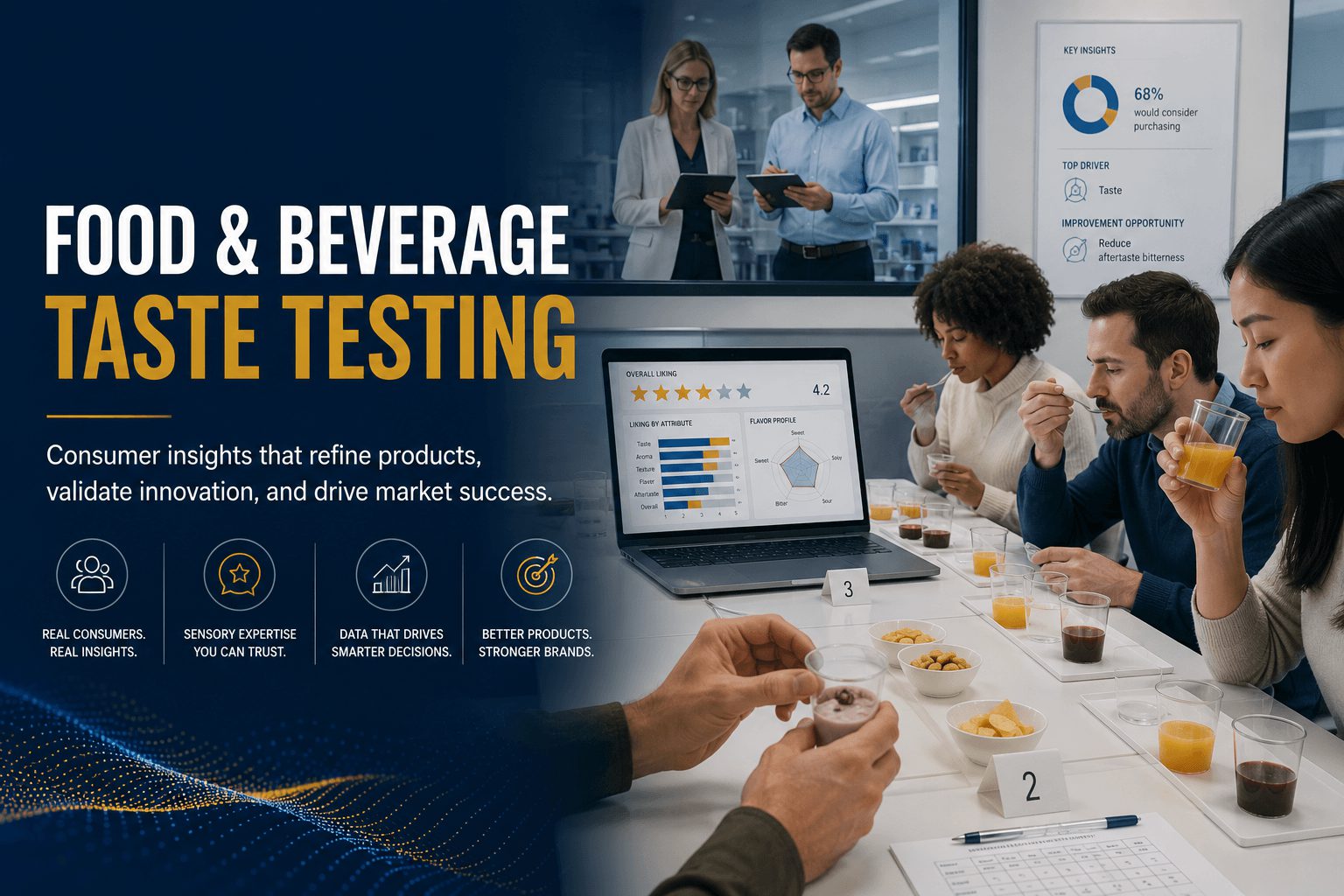
SIS International’s taste testing services are designed to assess current products, inspire innovation and identify alignment with emerging market trends.
Food and Beverage Taste Testing separates products that scale from products that stall on shelf. The winners treat sensory work as a strategic asset, not a validation checkpoint before launch.
The gap between category leaders and challengers rarely comes down to marketing spend. It comes down to how disciplined the sensory program is, how early it starts, and how tightly it connects to the concept, the claim, and the shelf-life window. Leadership teams that fund this discipline see faster launches, cleaner reformulations, and stronger private label defense.
Table of Contents
Why Sensory Discipline Now Drives Category Leadership
Three forces have raised the value of rigorous Food and Beverage Taste Testing. Clean label reformulation is stripping sugar, sodium, and fat from established products, and consumers notice the sensory drift immediately. Plant-based protein platforms continue to expand into dairy, meat, and seafood adjacencies, where the sensory gap against animal reference products remains the primary purchase barrier. Private label programs at Kroger, Aldi, and Costco have closed the quality perception gap in most center-store categories, which forces branded manufacturers to defend a measurable taste premium.
Each of these forces punishes brands that treat sensory testing as a final gate. The teams that win reformulation battles run descriptive analysis panels in parallel with R&D iteration, not after it.
What Drives Food and Beverage Purchases
Share of consumers who say each factor has a strong impact on their food and drink choices, with taste standing clearly above every other driver
Source 1: Food and Health Survey on Purchase Drivers
Source 2: SIS International Food and Beverage Taste Testing
Central Location Test (CLT) Design Separates Signal From Noise
Central Location Test (CLT) Design remains the workhorse methodology for consumer sensory decisions, and the design choices matter more than the sample size. Sequential monadic protocols reduce carryover bias in beverages with strong aftertaste. Blind branded comparisons isolate the halo effect that inflates or deflates scores when the logo is visible. Triangle tests and duo-trio tests answer discrimination questions that hedonic scales cannot.
Serving order, palate cleansers, temperature control, and cell size per rotation all shift results by measurable margins. A CLT that ignores these controls produces directional noise dressed up as consumer truth. According to SIS International Research, brands that pair sequential monadic CLTs with penalty analysis on JAR (just-about-right) scales consistently identify the two or three attributes driving overall liking, which compresses reformulation cycles by one to two rounds.
Why Do Businesses Need Food and Beverage Taste Testing
Food and beverage taste testing offers critical insights into consumer preferences, providing a direct feedback loop from the target audience. This feedback is invaluable for tailoring products to meet and exceed consumer expectations, ensuring that new launches are well received and that existing products continue to satisfy.
Additionally, food and beverage taste testing ensures that products remain consistent across batches and locations, which is particularly critical for brands with multiple outlets. Moreover, taste testing facilitates innovation by allowing businesses to explore new flavors, ingredients, and culinary techniques safely. This exploration is essential for keeping the product lineup fresh and exciting, attracting new customers, and retaining existing ones.
In any case, food and beverage taste testing brings many benefits for businesses, including:
- Consumer Preference Insights: Regular taste testing provides invaluable insights into consumer preferences, enabling businesses to tailor their offerings to match current tastes and trends.
- Innovation and Differentiation: Taste testing serves as a platform for innovation, encouraging the exploration of new flavors, ingredients, and culinary techniques.
- Risk Mitigation: Taste testing helps identify potential issues or areas for improvement before products reach the market.
- Brand Loyalty and Trust: Consistent quality and responsiveness to consumer preferences, achieved through ongoing taste testing, build brand loyalty and trust. Consumers are more likely to stay loyal to brands that consistently deliver high-quality, appealing products that reflect their tastes and preferences.
- Strategic Marketing Content: Insights from taste testing can inform marketing strategies, providing authentic content that highlights the sensory attributes and quality of the products.
Why Taste Decides Which Products Survive
The stakes behind sensory discipline, showing how central taste is to purchase and how often products fail without it
Source 1: Taste as a Purchase Driver and Product Launch Failure Study
Source 2: SIS International Food and Beverage Taste Testing
Quantitative Descriptive Analysis (QDA) Builds the Reformulation Map
Quantitative Descriptive Analysis (QDA) is where trained panels replace consumer opinion with calibrated measurement. A properly calibrated QDA panel scores intensity of specific sensory attributes such as caramelized notes, astringency, mouthcoating, or metallic finish on defined scales. That output creates the sensory map R&D uses to move a formulation toward a target.
Consumer liking data tells the team a product scores 6.2 on a nine-point hedonic scale. QDA tells them why. Pair the two and penalty analysis surfaces the specific attribute pushing liking down, which is the input R&D can actually work with. This pairing is what turns Food Product Flavor Profiling from a descriptive exercise into a reformulation instrument.
Concept-Product Fit Testing Prevents Expensive Misalignment
Concept-Product Fit Testing catches the failure mode where the product tastes fine on its own but disappoints against the concept it was sold on. A "bold and smoky" positioning tested against a mild formulation produces a satisfaction gap that no packaging redesign will close. A "creamy indulgent" claim on a reduced-fat product fails the same way.
The discipline sequences concept exposure, blind product trial, and branded product trial across matched cells. The delta between blind and branded scores measures the equity contribution of the brand. The delta between concept expectation and product delivery measures claim risk. Both numbers belong in the launch decision memo.
Private Label Taste Parity Has Become a Defensive Priority
Private Label Taste Parity testing is now standard practice for branded manufacturers in coffee, snacks, dairy, and ready meals. Retailer brands from Trader Joe's, Whole Foods 365, and Great Value have narrowed or eliminated the sensory gap in categories where branded incumbents assumed protection. The question for a category leader is not whether parity exists, but where the remaining sensory advantages sit and whether consumers can detect them in a blind protocol.
When blind triangle tests show consumers cannot discriminate between the branded product and the private label at a statistically meaningful rate, the pricing premium is exposed. When they can discriminate, the specific attributes driving preference become the defensible territory the brand should amplify in packaging, communication, and future line extensions.
Critical Success Factors for Successful Food and Beverage Taste Testing

For food and beverage taste testing to be effective and deliver valuable insights, several critical success factors must be considered – and here's what businesses need to focus on for successful taste testing:
- Representative Sample Group: It is crucial to select a group of participants that accurately represents the target market.
- Controlled Testing Environment: To obtain reliable and consistent results, it's important to conduct taste testing in a controlled environment where external factors such as noise, temperature, and odors are minimized.
- Structured Evaluation Criteria: Developing a structured evaluation framework with clear criteria for assessing the product's sensory attributes (such as taste, aroma, texture, and appearance) ensures that feedback is comprehensive and comparable across different products or testing sessions.
- Effective Data Analysis: Effectively collecting and analyzing the data is crucial for translating taste test results into actionable insights.
- Follow-Up Actions: The success of a taste testing process is determined by the follow-up actions taken based on the insights gained. Implementing improvements, making informed decisions about product launches, and continuously refining products based on feedback are essential to leveraging the full value of taste testing.
Shelf-Life Sensory Benchmarking Protects the Brand Between Production and Purchase
Shelf-Life Sensory Benchmarking answers a question consumer research often skips: does the product a shopper opens at week 26 taste like the product that scored well in the CLT at week 2? Accelerated shelf-life testing (ASLT) protocols model oxidation, staling, moisture migration, and flavor scalping from packaging under elevated temperature and humidity conditions.
The sensory drift that emerges over shelf life is often the true cause of repeat purchase decay in categories such as cold brew, refrigerated plant-based milks, and premium snack lines. Trained descriptive panels tracking the product across its stated code date reveal the point at which sensory quality falls below the acceptance threshold, which then informs packaging investment, distribution radius, and code date decisions.
Where the Best Programs Invest Differently
Leading programs share three habits. They run sensory work in parallel with R&D iteration rather than at the end. They pair trained panel descriptive data with consumer hedonic data on every meaningful decision. They test against the actual competitive shelf and the actual private label rival, not against an internal predecessor product.
They also invest in facility and recruitment quality. A CLT run in a purpose-built sensory booth with controlled lighting, ventilation, and recruitment screening produces cleaner data than a hotel ballroom with a convenience sample. In SIS International's central location testing across FMCG categories in New York and other major consumer markets, recruitment tightness and booth-level controls consistently explained more variance in result reliability than sample size within the range most brands actually field.
The Rising Investment in Sensory Testing
Projected growth of the global food and beverage sensory testing sector, indexed to a base value of one hundred and compounding at roughly eight percent each year
Demand is projected to grow by roughly seven tenths over a seven year horizon, driven by clean label reformulation, faster launch cycles, and rising quality expectations
Source 1: Food Sensory Testing Market Size and Growth Forecast
Source 2: SIS International Food and Beverage Taste Testing
Connecting Sensory Investment to Commercial Outcomes
The C-suite question is rarely whether to test. It is how much sensory investment produces measurable commercial return. The answer sits in three metrics: reduction in reformulation cycles, lift in repeat purchase rates from concept-product alignment, and defended pricing premium against private label. A disciplined Food and Beverage Taste Testing program moves all three.
Brands that treat sensory work as the connective tissue between R&D, marketing, and category management build products consumers choose again. That is the compounding advantage the discipline delivers.
What Makes SIS International a Top Food and Beverage Taste Testing Company?
SIS International is a food and beverage taste testing leader, helping brands refine their offerings to meet consumer expectations. With over 40 years of expertise, advanced methodologies, and a customer-focused approach, we deliver results that empower businesses to innovate and succeed in competitive markets.
Extensive Expertise Across the Food and Beverage Industry
Our experience spans diverse food and beverage categories, from packaged snacks and ready-to-eat meals to soft drinks and specialty beverages. We understand the unique challenges of each category and tailor our research to deliver actionable insights for improvement.
State-of-the-Art Testing Facilities
SIS International’s facilities in New York are equipped with advanced sensory analysis tools and controlled environments. These resources enable precise evaluations of taste, aroma, texture, and appearance, ensuring reliable results for every study.
Access to Diverse and Representative Consumer Panels
New York’s multicultural population provides a rich pool of participants for our taste tests. We recruit a broad range of demographics, ensuring feedback reflects the preferences of your target audience across various markets.
Customized Testing Approaches for Every Brand
No two businesses are the same. SIS develops bespoke taste testing strategies, whether you need monadic testing, sequential analysis, or central location tests. Our solutions are designed to address your specific goals and challenges.
Decades of Market Research Excellence
With over four decades of experience, SIS has built a reputation for delivering accurate and actionable research. Our expertise allows us to identify trends, uncover insights, and provide guidance that helps brands innovate and thrive.
Cost-Effective, High-Value Services
SIS offers top-tier taste testing services at competitive prices. We believe in making premium market research accessible to businesses of all sizes, ensuring high-value results without straining budgets.
Rapid and Reliable Results
In the fast-paced food and beverage industry, quick decision-making is essential. SIS ensures a streamlined process and fast turnaround times, enabling you to act on insights swiftly and efficiently.
Actionable Insights That Drive Product Success
Taste testing is more than collecting opinions. SIS analyzes data to deliver insights that guide product refinement, from flavor adjustments to packaging tweaks, ensuring your offerings align with consumer preferences.
Commitment to Objectivity and Quality
Our rigorous testing protocols eliminate bias and focus on consumer perceptions, ensuring objective results. SIS is committed to maintaining the highest quality standards in every research project.
Partnering for Long-Term Success
SIS International isn’t just a service provider; we’re a strategic partner. Our collaborative approach ensures clients receive personalized attention, actionable recommendations, and ongoing support to achieve their goals.
FAQs
What is Food and Beverage Taste Testing?
How does Central Location Test (CLT) Design differ from home use testing?
When should Quantitative Descriptive Analysis (QDA) be used?
How do brands measure the sensory gap against private label products?
What role does penalty analysis play in reformulation?
Our Facility Location in New York
11 E 22nd Street, Floor 2, New York, NY 10010 T: +1(212) 505-6805
About SIS International
SIS International offers Quantitative, Qualitative, and Strategy Research. We provide data, tools, strategies, reports, and insights for decision-making. We also conduct interviews, surveys, focus groups, and other Market Research methods and approaches. Contact us for your next Market Research project.