
B2B Market Research Firm










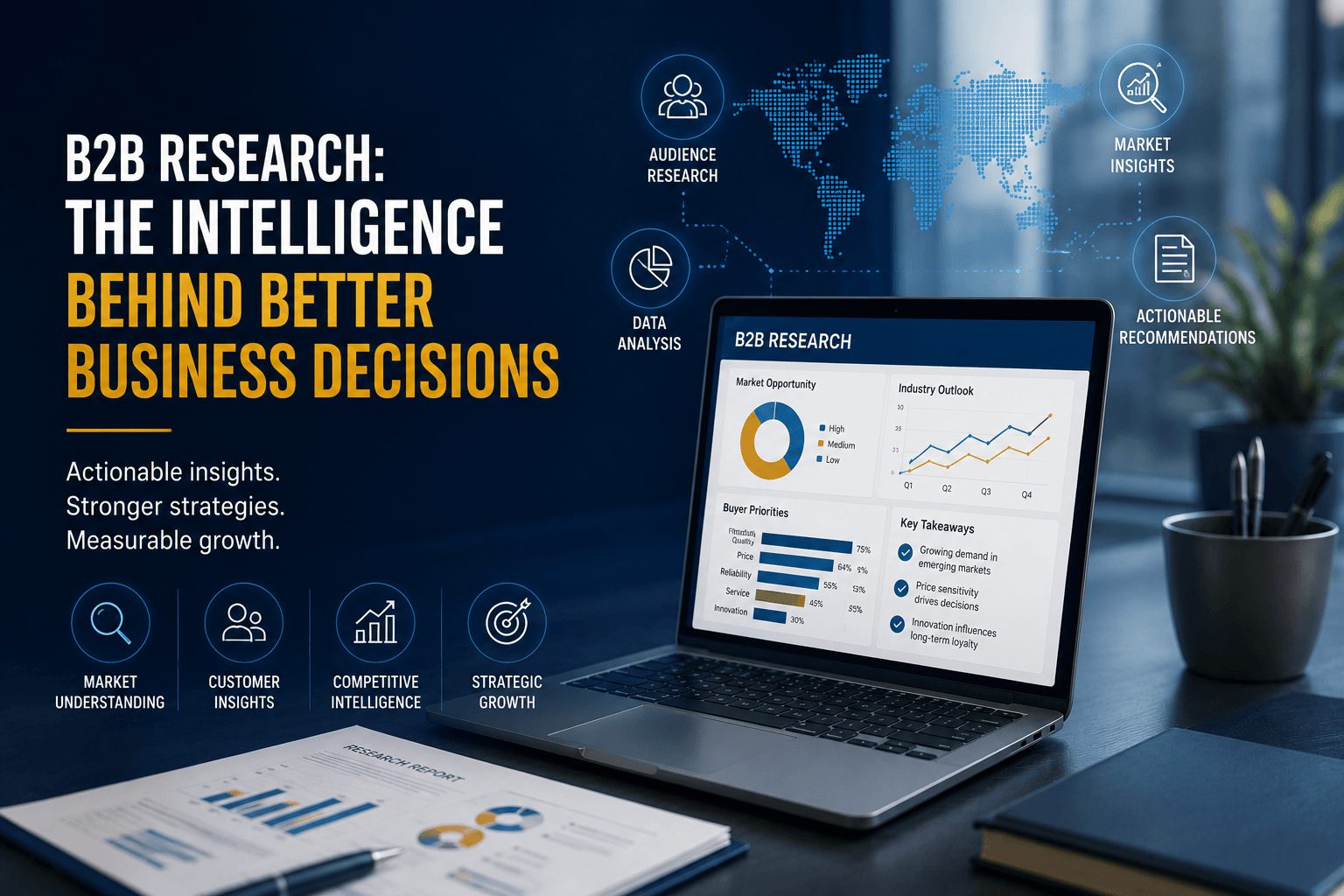







As a B2B market research firm, SIS International helps organizations understand who makes purchasing decisions, how buyers evaluate suppliers, which competitors influence the market, and where demand is changing.
SIS International is a B2B market research agency that helps organizations answer these questions through qualitative research, quantitative research, and strategic market intelligence.
Our research supports companies evaluating new markets, developing products, assessing competitors, improving customer relationships, and making decisions about business growth.
From interviewing specialized decision-makers to conducting international market studies, we help businesses understand the people, organizations and market conditions shaping their opportunities.
Discuss your B2B market research project with SIS International.
What Is B2B Market Research?
Business-to-business (B2B) market research examines the markets, customers, competitors, and purchasing decisions that influence transactions between organizations.
Unlike consumer research, which often focuses on individual purchasing preferences, B2B research frequently involves multiple stakeholders within the same organization.
A company purchasing enterprise software, for example, may involve an IT director, finance team, procurement department, operational managers and senior executives. Each stakeholder may evaluate the same product against different criteria.
B2B market research helps companies understand those criteria and how they influence the purchasing process.
Research can investigate:
- Market size and potential demand
- Customer needs and purchasing behavior
- Competitor positioning
- Supplier evaluation criteria
- Pricing and willingness to pay
- Product and service requirements
- Customer satisfaction and retention
- Opportunities for geographic expansion
- Industry trends and emerging technologies
These insights help organizations make decisions based on a clearer understanding of the markets they serve.
B2B Market Research Services
SIS International provides B2B research services designed around specific business questions. Depending on the project, research may involve one methodology or a combination of approaches.
Market Sizing and Opportunity Assessment
Before entering a market or launching a new offering, companies need to understand the size and characteristics of the opportunity.
Market sizing research can estimate the number of potential customers, evaluate demand across segments and identify the factors influencing market growth.
This may involve examining industries, company sizes, geographic markets, purchasing patterns and the competitive environment.
Market opportunity research can help organizations determine where to prioritize investment and which customer segments warrant further investigation.
Competitive Intelligence
Competitors influence how customers evaluate products, services and suppliers.
B2B competitive intelligence examines competitor offerings, pricing, positioning, distribution, customer perceptions and market activity.
Research may also explore why buyers choose one supplier over another and which needs remain underserved.
These findings can inform product development, sales strategies, marketing messages and competitive positioning.
B2B Customer Research
Understanding existing and prospective customers is essential in markets where purchasing decisions can involve long evaluation periods and several decision-makers.
Customer research can identify:
- Purchasing priorities
- Unmet needs
- Satisfaction with existing suppliers
- Reasons for switching providers
- Product and service expectations
- Decision-making responsibilities
- Barriers to purchase
- Opportunities to improve retention
SIS International uses qualitative and quantitative methods to investigate these issues across relevant customer groups.
Market Segmentation
Not every business customer has the same requirements.
A small company may prioritize affordability and ease of implementation, while a large enterprise may place greater emphasis on integration, security, procurement requirements and long-term support.
Market segmentation helps companies distinguish between customer groups based on characteristics such as industry, organization size, geography, purchasing behavior and operational needs.
Effective segmentation can support more relevant product offerings, marketing strategies and sales approaches.
Product and Concept Testing
B2B product development benefits from understanding how prospective buyers respond before a product reaches the market.
Product and concept testing can evaluate:
- Relevance to customer needs
- Product features
- Ease of use
- Differentiation from competitors
- Pricing expectations
- Purchase interest
- Implementation concerns
Research can also identify differences between the needs of purchasing decision-makers and the employees who will use a product or service.
Pricing Research
B2B pricing decisions can be complicated by negotiated contracts, purchasing volume, implementation costs and long-term supplier relationships.
Pricing research helps companies understand how buyers evaluate value, compare alternatives and respond to different pricing structures.
Depending on the market, this may involve qualitative interviews, surveys, competitive analysis and concept testing.
Customer Journey Mapping
A B2B purchase rarely consists of a single interaction.
Prospective customers may discover a supplier, conduct independent research, consult colleagues, request demonstrations, compare proposals and complete internal approvals before making a decision.
Customer journey mapping examines these interactions to identify what buyers need at each stage and where uncertainty or friction may delay a purchase.
Research can also explore the customer experience after purchase, including onboarding, service, renewal and retention.
Market Entry and International Expansion
Entering a new geographic market requires understanding more than its potential customer base.
Companies may need to evaluate local competitors, distribution channels, buyer expectations, purchasing practices and regulatory considerations.
SIS International supports international market research that helps organizations compare opportunities and understand how business conditions differ across markets.
B2B Market Research Methods
The appropriate methodology depends on the research question, target audience, market and decisions the findings will support.
SIS International combines qualitative research, quantitative research and secondary research to develop a more complete understanding of B2B markets.
In-Depth Interviews
In-depth interviews allow researchers to explore the experiences, motivations and decision-making processes of individual participants.
B2B interviews may involve procurement directors, IT decision-makers, R&D managers, business owners, senior executives and other professionals.
These conversations can investigate how organizations evaluate suppliers, what influences purchasing decisions and which challenges customers need a product or service to solve.
Interviews may be conducted in person, by telephone or through video conferencing.
Quantitative Surveys
Quantitative surveys help organizations measure attitudes, preferences and behaviors across a defined population.
B2B surveys can assess customer satisfaction, product interest, brand awareness, purchasing criteria, pricing expectations and market trends.
Survey design is particularly important when the target population includes organizations with different sizes, structures and purchasing responsibilities.
A sample of business owners may produce very different findings from a sample of procurement directors or technical decision-makers.
Focus Groups
B2B focus groups bring participants together to discuss a research topic under the guidance of a moderator.
They can be used to explore product concepts, customer needs, brand perceptions, marketing messages and purchasing considerations.
Focus groups can also reveal differences in how professionals approach similar decisions across industries or organizational roles.
For specialized B2B audiences, careful participant recruitment is essential.
Online Focus Groups
Online focus groups allow participants to join moderated discussions through video, audio or chat.
This format can be useful when decision-makers are geographically dispersed or difficult to assemble in one location.
It also allows organizations to include participants from multiple markets without requiring everyone to travel.
Online Insight Communities
Online insight communities allow participants to contribute feedback over several days rather than during a single interview or group discussion.
Participants may respond to prompts, complete exercises, discuss ideas and evaluate concepts at convenient times.
This approach can provide additional time for reflection and allow researchers to examine how opinions develop throughout a study.
Secondary Research and Desk Research
Secondary research examines existing information to understand a market before or alongside primary research.
Sources may include industry publications, company reports, government statistics, regulatory information, trade associations and other relevant materials.
Desk research can help identify competitors, estimate market characteristics, examine industry developments and determine which questions require further primary research.
Observational Research
Observational research examines behavior in relevant business settings.
Depending on the project, this may involve trade shows, industry events, customer interactions or workplace environments.
Observation can reveal differences between what participants report doing and how activities actually occur.
Expert Panels
Expert panels bring together professionals with specialized knowledge of an industry, technology or market.
These discussions can help organizations understand emerging developments, evaluate opportunities and examine complex market questions from several professional perspectives.
Reaching the Right B2B Decision-Makers
One of the defining challenges of B2B market research is identifying and recruiting the right participants.
A business may employ hundreds or thousands of people, but only a small number may influence a particular purchasing decision.
For example, research involving enterprise cybersecurity products may require interviews with IT and security leaders rather than a general sample of employees.
A study of industrial equipment purchasing may need procurement specialists, plant managers, engineers and operational decision-makers.
SIS International recruits participants from specialized professional audiences, including IT decision-makers, procurement directors and R&D managers.
The goal is to ensure that research reflects the people who understand, influence or make the decisions being studied.
Why Company Size Matters in B2B Research
Company size can influence purchasing budgets, supplier requirements, decision-making structures and research eligibility.
Large enterprises may have formal procurement processes and multiple approval stages. Smaller businesses may rely more heavily on owners or individual managers.
A sample dominated by small firms may not accurately represent a market in which most purchasing activity comes from larger organizations.
For that reason, B2B research may need to account for organization size alongside industry, geography and professional role.
Editorial implementation note: Retain the existing chart, interactive elements, figures and associated explanatory content. Do not recreate the visualization as static copy.
The U.S. Census Bureau’s Statistics of U.S. Businesses provides data on employer businesses by industry and enterprise size, offering useful context for defining a B2B research audience.
Why B2B Research Samples Need to Be Current
Business populations change over time.
New companies enter markets, existing businesses close, organizations merge and employees move into different roles.
These changes can affect the accuracy of business contact lists and the eligibility of research participants.
Research design should therefore consider the age and quality of its sample sources, particularly when studying young businesses or markets undergoing substantial change.
Editorial implementation note: Retain the existing chart and accompanying data.
Researching Industries With Different Business Survival Patterns
The rate at which businesses enter and leave a market can vary across industries.
This matters when estimating addressable markets, recruiting participants and maintaining research databases.
A research program focused on established manufacturers may require a different sampling approach from one focused on newly formed technology businesses.
Industry characteristics should therefore inform research design rather than relying on a single sampling strategy across every sector.
Editorial implementation note: Preserve the existing sortable industry table and its underlying figures without modification.
Industries We Research
B2B markets differ substantially in their customers, purchasing processes, competitive dynamics and research requirements.
SIS International’s research experience spans multiple industries, including:
Technology and SaaS: Research into enterprise software, digital services, emerging technologies, customer needs and competitive positioning.
Financial Services: Research involving financial institutions, payment services, financial technology, business customers and market opportunities.
Healthcare and Life Sciences: Research into industry developments, professional audiences, market access and business purchasing requirements.
Manufacturing and Industrial Products: Research involving equipment, components, suppliers, procurement practices and industrial demand.
Automotive and Transportation: Research into vehicle markets, suppliers, distribution, customer requirements and industry developments.
Consumer Goods and Retail: Research involving business customers, distribution relationships, product development and competitive dynamics.
Research programs can be designed around the specific characteristics of each industry rather than applying the same approach to every market.
Global B2B Market Research
International B2B research requires an understanding of how business conditions and purchasing behavior differ across countries.
A product that succeeds in one market may face different customer expectations, distribution structures, competitors or regulatory requirements elsewhere.
SIS International conducts research across markets in North America, Europe, Asia and Latin America.
Global research programs can help organizations:
- Compare market opportunities
- Understand local customer needs
- Identify competitors
- Evaluate purchasing practices
- Test products and concepts
- Examine market entry barriers
- Develop region-specific strategies
Research design should account for local market conditions while maintaining enough consistency to compare findings across countries.
Why Work With SIS International?
Choosing a B2B market research agency requires confidence that the research team can understand the business problem, reach the relevant audience and translate findings into useful information.
SIS International combines research methodologies with experience across industries and international markets.
Experience With Complex B2B Audiences
B2B research often involves specialized participants whose professional knowledge is essential to the study.
SIS International recruits and interviews business decision-makers, technical professionals and other industry participants according to project requirements.
Qualitative and Quantitative Capabilities
Different research questions require different forms of evidence.
Qualitative research can explain motivations and purchasing processes, while quantitative research can measure patterns across a larger population.
Combining methods can help organizations understand both what is happening in a market and why.
International Research Capabilities
Organizations operating across borders need research that reflects local market conditions.
SIS International’s international research experience supports projects involving individual countries and multiple geographic markets.
Experience Across Established Organizations
SIS International’s published list of past and present clients includes organizations such as Apple, Cisco, Cummins, Ford Motor Company, General Electric, IBM, Motorola, Samsung, Siemens and Toyota.
These examples reflect the range of industries represented in the firm’s published client experience.
[OPTIONAL DESIGN ELEMENT: Selected past and present client logos, subject to SIS approval and existing usage permissions.]
Frequently Asked Questions About B2B Market Research
What does a B2B market research agency do?
A B2B market research agency studies business customers, markets, competitors and purchasing behavior to help organizations make informed decisions about products, services, pricing, marketing and growth.
How is B2B market research different from B2C research?
B2B research focuses on organizations and professional purchasing decisions. These decisions may involve several stakeholders, specialized requirements, negotiated pricing and longer buying cycles. B2C research generally focuses on individual consumers and household purchasing behavior.
Which B2B market research methods should companies use?
Common methods include in-depth interviews, quantitative surveys, focus groups, expert panels, secondary research and observational research. The appropriate combination depends on the business question and target audience.
How do you recruit B2B research participants?
Participant recruitment begins by defining the relevant industry, company characteristics, professional responsibilities and purchasing influence. Researchers then identify and screen participants who meet those requirements.
Why is B2B market segmentation important?
Segmentation helps organizations distinguish between customer groups with different needs, budgets, purchasing behaviors and decision-making processes. These differences can inform product development, sales and marketing strategies.
Can B2B market research support international expansion?
Yes. International research can help organizations assess demand, understand local competitors, evaluate customer expectations and identify barriers to entering new markets.
How long does a B2B market research project take?
Timelines depend on the research objectives, methodology, target audience, number of markets and difficulty of participant recruitment. Specialized executive research or multinational studies may require more preparation than a narrowly focused domestic survey.
How much does B2B market research cost?
Costs vary according to project scope, methodology, sample size, audience accessibility and geographic coverage. A research proposal can establish the appropriate approach and budget for the decisions the study needs to support.
Discuss Your B2B Market Research Project
Whether your organization is entering a new market, evaluating a product, researching competitors or seeking a better understanding of business customers, the right research begins with a clearly defined question.
SIS International can help design a B2B market research program around your objectives, target audience and geographic requirements.
Contact SIS International to discuss your research project.