
Autonomous Vehicle Market Research

The autonomous vehicle industry is revolutionizing how we think about transportation, promising safer, smarter, and more efficient mobility.
Autonomous vehicles are no longer a futuristic concept—they are becoming a reality with significant advancements. However, companies need robust autonomous vehicle market research to navigate this complex and rapidly evolving industry.
What is Autonomous Vehicle Market Research?
Autonomous vehicle market research focuses on understanding the evolving dynamics of the self-driving car industry. One of the core objectives is to gauge public perceptions and expectations. Self-driving technology often faces skepticism regarding safety, reliability, and practicality. So, by gathering data on these concerns, companies can refine their offerings and craft effective communication strategies to build consumer trust.
Additionally, this type of research tracks industry trends, such as advancements in AI systems, sensor technologies, and connectivity solutions. It helps businesses identify new opportunities, such as autonomous delivery services or urban mobility solutions, ensuring they stay ahead of the competition.
Applications of Autonomous Vehicle Market Research
Autonomous vehicle market research is a cornerstone for innovation and strategic decision-making. That’s why uncovering consumer insights and technological opportunities enables businesses to refine their products, address challenges, and stay ahead of the competition. Below are some key applications of autonomous vehicle market research:
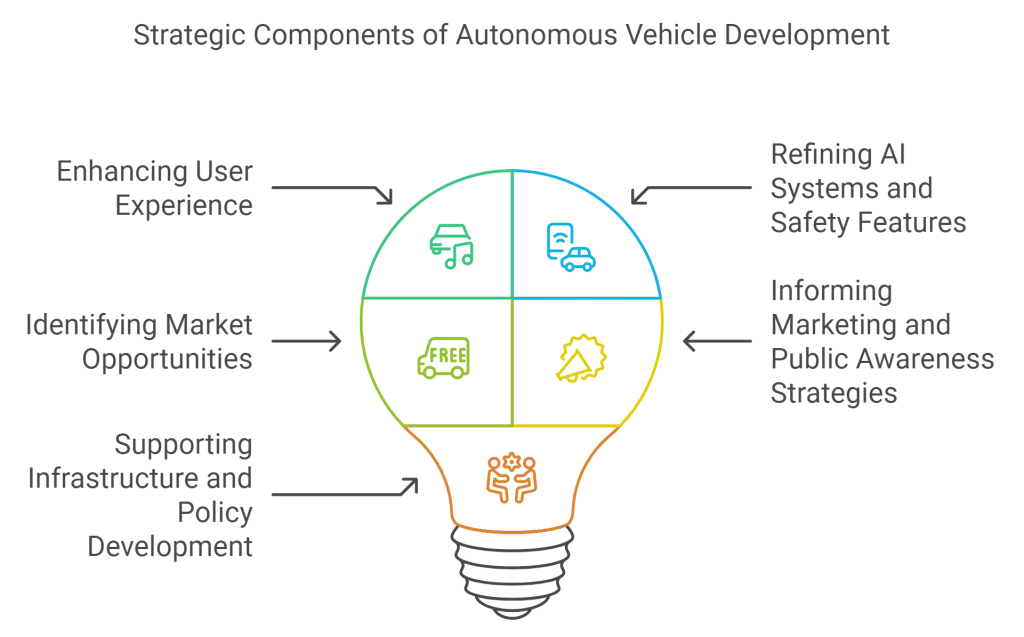
1. Enhancing User Experience
Understanding the needs and expectations of end-users is essential for creating autonomous vehicles that resonate with consumers. Market research helps businesses explore user preferences for comfort, design, and technological features. For instance, insights into consumer demand for personalized in-vehicle entertainment or seamless integration with mobile devices can drive the development of features that enhance user satisfaction.
2. Refining AI Systems and Safety Features
Autonomous vehicle market research is essential in assessing the performance and public perception of AI-driven systems. Companies can use research findings to identify areas for improvement in navigation, obstacle detection, and decision-making processes. Additionally, understanding consumer concerns about safety enables manufacturers to focus on features that increase trust, such as redundant safety systems and real-time diagnostics.
3. Identifying Market Opportunities
Research helps businesses uncover new market opportunities within the autonomous vehicle ecosystem. For example, the growing demand for autonomous delivery services and ride-sharing platforms presents significant growth prospects.
4. Informing Marketing and Public Awareness Strategies
Effective communication is key to overcoming public skepticism about autonomous vehicles. Market research guides businesses in crafting messaging that addresses consumer concerns and highlights the benefits of self-driving technology. This includes educating audiences on safety, environmental sustainability, and cost efficiency, often top priorities for potential users.
5. Supporting Infrastructure and Policy Development
Autonomous vehicle market research extends beyond consumer insights to include infrastructure and policy considerations. Companies can use research to collaborate with governments and urban planners, ensuring that roads, communication networks, and traffic systems are equipped to support autonomous vehicles.
The Global Perspective on Autonomous Vehicle Market Research
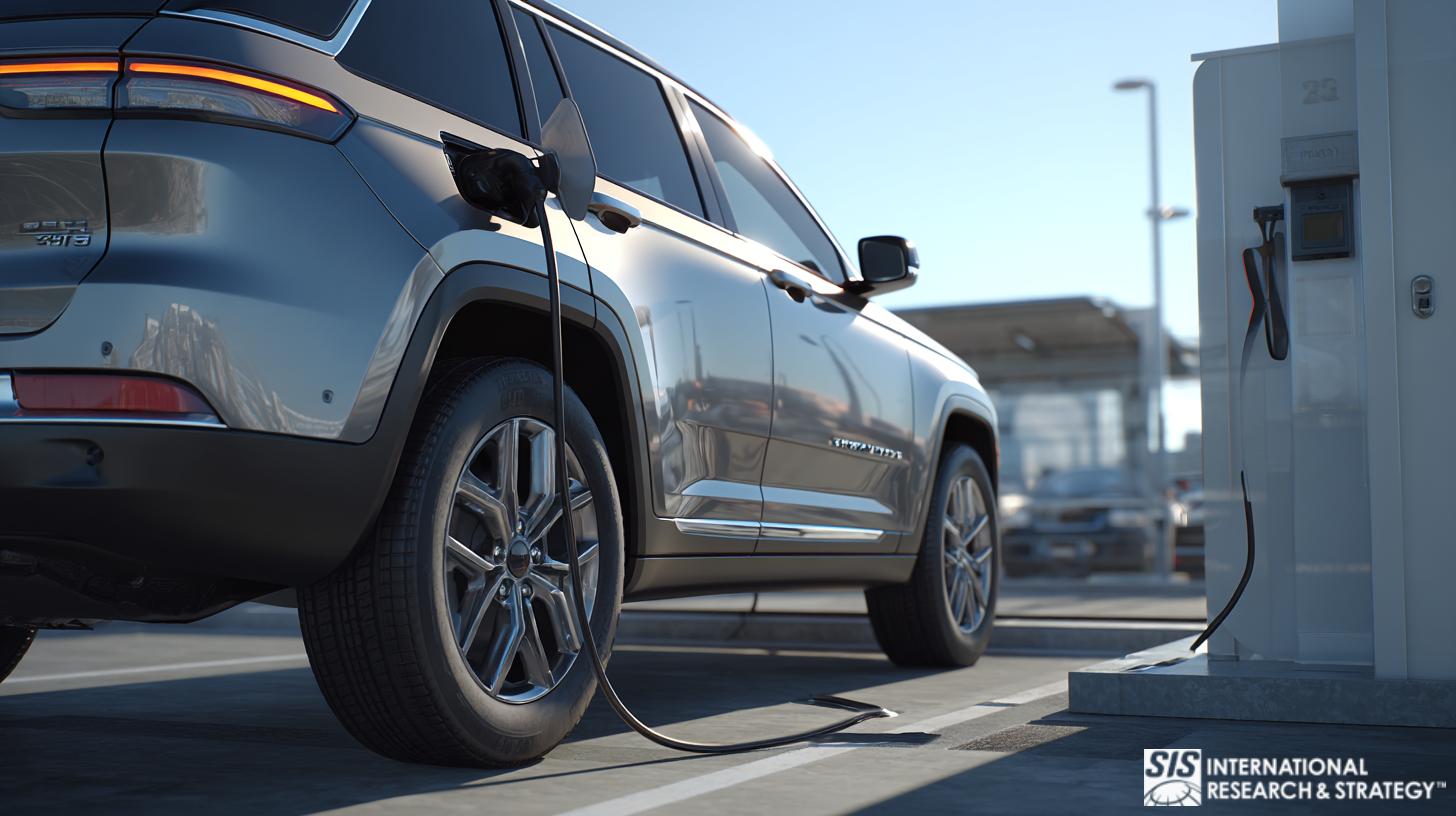
Autonomous vehicle market research takes on unique characteristics across different regions, shaped by cultural, economic, and regulatory factors. Addressing these variations is critical for companies aiming to succeed in the global marketplace. Each region offers distinct opportunities and challenges businesses must consider in their strategies.
1. North America: Pioneering Innovation and Early Adoption
The United States is at the forefront of autonomous vehicle development, with tech hubs like Silicon Valley driving innovation. Market research in North America focuses heavily on consumer trust, safety features, and regulatory hurdles. The region’s robust infrastructure and growing public awareness provide a strong foundation for companies to test and launch autonomous solutions. Canada is also emerging as a key player, particularly in testing autonomous systems in extreme weather conditions.
2. Europe: Sustainability and Urban Mobility
Europe’s focus on sustainability and smart urban mobility has influenced the trajectory of autonomous vehicle market research. Cities like Amsterdam, Berlin, and Stockholm are exploring how autonomous vehicles can integrate with existing public transportation systems. Research in this region often prioritizes environmental impact, congestion reduction, and compatibility with green initiatives. However, the fragmented regulatory landscape across EU member states poses challenges that require localized market insights.
3. Asia: Rapid Growth and Technological Advancements
Asia, particularly China and Japan, is experiencing rapid advancements in autonomous vehicle technology. China’s extensive investment in AI and infrastructure makes it a leading market for self-driving vehicles. At the same time, Japan emphasizes precision engineering and safety. Autonomous vehicle market research in Asia often addresses unique cultural preferences, such as the demand for high-tech, feature-rich vehicles and seamless integration with smart city technologies.
4. Emerging Markets: Opportunities and Infrastructure Gaps
Emerging markets in Latin America, Africa, and Southeast Asia offer untapped opportunities for autonomous vehicle adoption. However, these regions face infrastructure and regulatory challenges that companies must address through targeted market research. For example, understanding the needs of local logistics and transportation industries can uncover opportunities for autonomous commercial vehicles.
5. Regional Collaboration and Policy Alignment
Global market research also highlights the importance of regional collaboration in advancing autonomous vehicle adoption. Research insights can guide governments and industry stakeholders in harmonizing policies, sharing technological advancements, and building infrastructure that supports cross-border mobility solutions.
Key Challenges in Autonomous Vehicle Market Research
Despite its transformative potential, autonomous vehicle market research presents unique challenges for businesses, including:
1. Regulatory Uncertainty
One of the most significant hurdles in autonomous vehicle market research is understanding the constantly evolving regulatory landscape. Laws and policies governing autonomous vehicles vary widely across regions, making it difficult for businesses to predict how these rules might affect product launches or market entry. For instance, while some countries embrace autonomous technology with supportive legislation, others impose strict restrictions that limit development and testing.
2. Consumer Trust and Adoption Rates
Public trust remains a critical barrier to widespread adoption of autonomous vehicles. Many consumers express concerns about safety, reliability, and data privacy, which can hinder market growth.
3. Technological and Infrastructure Limitations
Autonomous vehicles use advanced AI, sensors, and communication systems to operate effectively. However, gaps in infrastructure—such as insufficient 5G coverage or lack of smart roadways—pose significant challenges.
4. Global Variability in Consumer Preferences
The diversity of consumer preferences across markets adds complexity to research efforts. While urban consumers may prioritize autonomous ride-sharing services, rural populations might focus on autonomous farming or logistics vehicles.
Key Job Titles
Notable jobs include:
- Market Research Analysts
- Data Analysts
- Mechanical Engineer
- Electrical Engineer
- Software Engineer
What Makes SIS International a Top Autonomous Vehicle Market Research Company
SIS International has earned its reputation as a leading autonomous vehicle market research provider, delivering unparalleled insights and strategies for businesses navigating this dynamic industry. With 4 decades of experience in market intelligence and a commitment to innovation, SIS International empowers companies to stay ahead in the rapidly evolving world of autonomous technology.
1. Advanced Methodologies and Cutting-Edge Tools
SIS International employs state-of-the-art research methodologies tailored to the unique demands of the autonomous vehicle sector. We leverage advanced tools to gather qualitative and quantitative data from virtual focus groups to in-depth ethnographic studies.
2. Expertise in Global Market Dynamics
With a global presence and a vast network of research professionals, SIS excels at uncovering regional and cultural nuances that influence the autonomous vehicle market. Whether analyzing European regulatory landscapes, Asian consumer preferences, or North America infrastructure needs, we provide localized insights that drive actionable strategies for businesses worldwide.
3. Tailored Solutions for Industry Leaders
SIS International’s research solutions are customized to meet clients’ specific needs in the autonomous vehicle industry. Our team collaborates closely with automakers, tech firms, and policymakers to address safety perceptions, AI system refinement, and market adoption challenges.
4. Proven Track Record in Cutting-Edge Industries
With extensive experience in high-tech and emerging industries, SIS is uniquely equipped to handle the complexities of autonomous vehicle market research. We have supported some of the world’s most innovative brands, helping them refine products, optimize marketing strategies, and anticipate market shifts.
5. Commitment to Actionable Insights
What sets SIS International apart is its focus on delivering insights that translate into real-world success. SIS goes beyond collecting data, providing strategic recommendations that help clients innovate, reduce risks, and seize new opportunities.
Our Facility Location in New York
About SIS International
SIS International offers Quantitative, Qualitative, and Strategy Research. We provide data, tools, strategies, reports, and insights for decision-making. We also conduct interviews, surveys, focus groups, and other Market Research methods and approaches. Contact us for your next Market Research project.
11 E 22nd Street, Floor 2, New York, NY 10010 T: +1(212) 505-6805
About SIS International
SIS International offers Quantitative, Qualitative, and Strategy Research. We provide data, tools, strategies, reports, and insights for decision-making. We also conduct interviews, surveys, focus groups, and other Market Research methods and approaches. Contact us for your next Market Research project.