纽约市焦点小组测试老年人产品

利用 NYC Focus Groups to Test Products for Seniors  

SIS 国际市场研究与战略

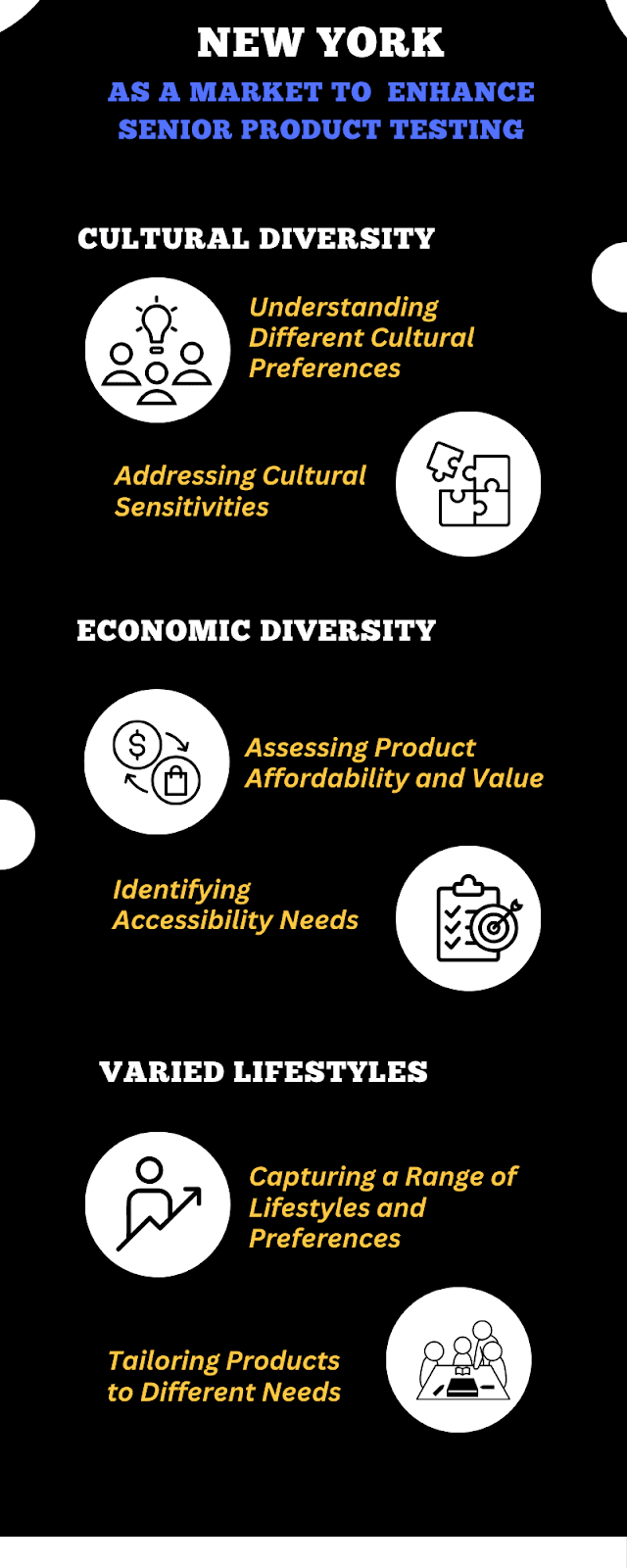
纽约市是世界上最多元化的市场之一,是面向包括老年人在内的各种消费群体测试产品的理想地点。随着老年人口的快速增长,企业拥有独特的机会来开发满足这一人群不断变化的需求的产品。这就是为什么在纽约市使用焦点小组来测试老年人产品可以直接了解他们的偏好、挑战和期望。 

了解纽约的老年市场

纽约市的老年人口数量庞大且多样化,因此成为企业开发产品时需要考虑的重要人群。 纽约市的老年人 老年人通常有独特的偏好,包括注重健康、保健、易用性和迎合其生活方式的技术。此外,许多老年人比以往任何时候都更精通技术,积极使用数字平台、设备和服务。这种复杂性使纽约成为了解老年人如何与产品互动以及哪些创新最能满足他们需求的理想地点。

纽约 Focus Groups to Test Products for Seniors: A Strategic Advantage for Fortune 500 Innovators

New York City offers a senior population unmatched in density, diversity, and purchasing power. For product teams targeting Americans aged 60 and over, this concentration produces faster recruitment, sharper segmentation, and more candid feedback than any other US market. NYC focus groups to test products for seniors give Fortune 500 brands a research environment where ethnographic depth, ergonomic evaluation, and concept refinement happen inside one trip.

The senior segment now drives discretionary spending across pharma adherence devices, mobility products, financial services, connected health, food formats, and assistive technology. Winning here requires evidence drawn from the actual user, not extrapolation from younger panels.

Why NYC Outperforms for Senior Product Testing

Manhattan, Queens, Brooklyn, and the Bronx contain seniors across every income tier, ethnicity, and living arrangement found nationally. A facility in Midtown can recruit a Russian-speaking 72-year-old from Brighton Beach, a Spanish-dominant grandmother from Washington Heights, and a retired finance executive from the Upper East Side into the same study week. That radius does not exist in Atlanta, Phoenix, or Chicago.

Density also matters for ergonomic and packaging studies. Seniors who use public transit, climb walk-up apartments, and shop multiple times weekly stress-test products in ways suburban panels cannot replicate. Grip strength tests for jar closures, font legibility on OTC labels, and one-handed device operation generate failure modes faster in this population.

According to SIS International Research, recruitment yield among adults 65+ in NYC runs materially higher than comparable Tier 1 metros, and segment fill rates for hard-to-reach criteria such as recent CGM adopters, post-cardiac event patients, or assisted-living decision makers close in days rather than weeks.

The Methodologies That Generate Decision-Grade Evidence

Senior research is not a single-method exercise. The strongest programs sequence methodologies against the decision the client owns.

Traditional focus groups work for early concept reaction, packaging triage, and message testing. Eight to ten participants over 90 minutes surface category language and unmet needs. Two-way mirrors allow brand teams from Procter & Gamble, Pfizer, or Bayer to observe live without distorting the room.

Ethnographic research in the participant’s home reveals how arthritis affects pill bottle opening, how cognitive load shapes remote control use, and where Medicare paperwork actually lives. This is where Philips, Abbott, and Johnson & Johnson have refined product affordances that lab settings miss.

Central location tests (CLTs) with rotating product stations work for taste testing reformulated nutrition products, evaluating wearable comfort over a two-hour wear period, or running JAR scale analysis on reduced-sodium foods. NYC’s facility infrastructure supports kitchens, simulated retail aisles, and vehicle bays in the same building.

Co-creation workshops bring seniors into the design process for telehealth interfaces, hearing aid app flows, and smart home controls. The output is not a survey result. It is a refined feature set the engineering team can build against.

What Leading Brands Do Differently

The conventional approach treats seniors as one cohort defined by age. The better approach segments by functional capability, technology fluency, caregiver involvement, and life stage. A 68-year-old marathon runner managing Type 2 diabetes shares almost nothing with an 82-year-old in early-stage cognitive decline. Pooling them produces averaged insight that fits neither.

SIS International’s qualitative work across consumer health, financial services, and connected device categories indicates that segmenting senior panels by activities of daily living (ADL) independence and digital adoption tier produces concept scores that predict in-market adoption substantially more reliably than age-banded segmentation.

Strong programs also recruit the caregiver dyad when relevant. Adult children of seniors often co-decide on hearing aids, Medicare Advantage plans, fall detection systems, and grocery delivery subscriptions. Testing the product with the senior alone misses the influence pathway that closes the sale.

The SIS Senior Research Framework

SIS 国际市场研究与战略
Dimension Junior Panel Approach Decision-Grade Approach
分割 Age band (65+) ADL tier, tech fluency, caregiver role
Setting Facility only Facility, home ethnography, retail intercept
Session length 2 hours standard Adjusted for fatigue, 60-75 minutes
Stimulus format Digital screens Physical product, large-print boards, tactile prototypes
输出 Verbatims and themes Refined concept, ergonomic findings, caregiver journey

Source: SIS International Research

Operational Considerations That Separate Strong Programs from Weak Ones

SIS 国际市场研究与战略

Session design for seniors deviates from standard qualitative practice. Seventy-five minutes is the working ceiling before fatigue degrades response quality. Lighting, seating height, hearing assistance, and pacing all affect data integrity. Moderators trained in geriatric communication avoid the leading questions that less experienced facilitators produce when participants pause.

Stimulus materials require physical formats. Concept boards at 18-point font minimum. Working prototypes rather than renderings. Packaging mock-ups that participants can actually open. Digital-only stimulus excludes the cognitive style of a meaningful share of the segment and biases findings toward the most digitally fluent quartile.

Recruitment screening should verify functional status without sounding clinical. Self-reported health status correlates poorly with actual capability. Behavioral screeners, asking what the participant did yesterday rather than what they can do, produce more accurate panels.

Where the Investment Pays Back

纽约市焦点小组测试老年人产品

Categories where NYC focus groups to test products for seniors generate the highest return on research spend include medication adherence packaging, OTC reformulations, Medicare Advantage plan design, hearing technology, mobility aids, financial fraud protection products, telehealth platforms, and food formats engineered for chewing or swallowing changes. Each category has a senior-specific failure mode that younger panels cannot detect.

The NYC market also functions as a leading indicator. Multigenerational households, immigrant senior populations, and urban aging-in-place patterns appearing in Queens and Brooklyn often precede national trends by several years. Brands that establish a recurring qualitative cadence in this market read the senior segment earlier than those that rely on syndicated trackers.

For Fortune 500 product, brand, and innovation teams, the question is not whether to invest in senior research. It is whether the current program is producing evidence the engineering and marketing teams can actually build against. NYC focus groups to test products for seniors, designed with proper segmentation and methodology sequencing, close that gap.

关于 SIS 国际

SIS 国际 提供定量、定性和战略研究。我们提供决策所需的数据、工具、战略、报告和见解。我们还进行访谈、调查、焦点小组和其他市场研究方法和途径。 联系我们 为您的下一个市场研究项目提供帮助。

作者照片

露丝-斯坦纳特

SIS 国际研究与战略创始人兼首席执行官。她在战略规划和全球市场情报方面拥有 40 多年的专业知识,是帮助组织取得国际成功的值得信赖的全球领导者。

满怀信心地拓展全球业务。立即联系 SIS International!

与专家交谈