Transportation & Logistics Market Research
The automotive industry has built some of the most complex global supply chains on Earth. To remain competitive requires extensive orchestration among supply chain partners, including firms providing transportation and logistics services. Automotive manufacturers and their logistics partners must closely align their objectives to continually improve cost, quality, and performance.
Market researchers can uncover insights from existing and prospective customers, extending the intelligence available to both industries and, in turn, enabling both partners to identify more opportunities to operate better, faster, and cheaper. Market research can identify unmet needs, anticipate demand for new services, and validate investment opportunities. These insights provide fertile ground for developing innovative, differentiated service offerings, strengthening competitive proposals, and capturing new business.
Symbiotic partners
Transportation is concerned with the physical movement of goods. Logistics, on the other hand, is broader, encompassing planning, execution, and management of the flow of goods throughout the supply chain. In the automotive industry, logistics includes inbound transportation of raw materials through to outbound distribution of finished goods, in this case, the transportation of finished vehicles to dealerships.
The automotive industry is ultimately driven by consumer demand, making it B2C overall if you think of dealerships as extensions of the enterprise rather than independent companies. However, the transportation and logistics firms supporting it operate primarily in a B2B environment. Ever-evolving consumer preferences push automotive manufacturers to continually adapt their products. This means logistics providers must adapt their capabilities to automotive manufacturers’ changing requirements. Demand for automotive logistics services can therefore be understood as derived demand for vehicles and the resulting production and distribution requirements.
Despite the close relationship between automotive manufacturers and their transportation and logistics partners, disconnects can emerge.
These disconnects are not necessarily between the partners themselves but arise from the velocity at which automotive market requirements evolve and the pace at which logistics capabilities can react and adapt.
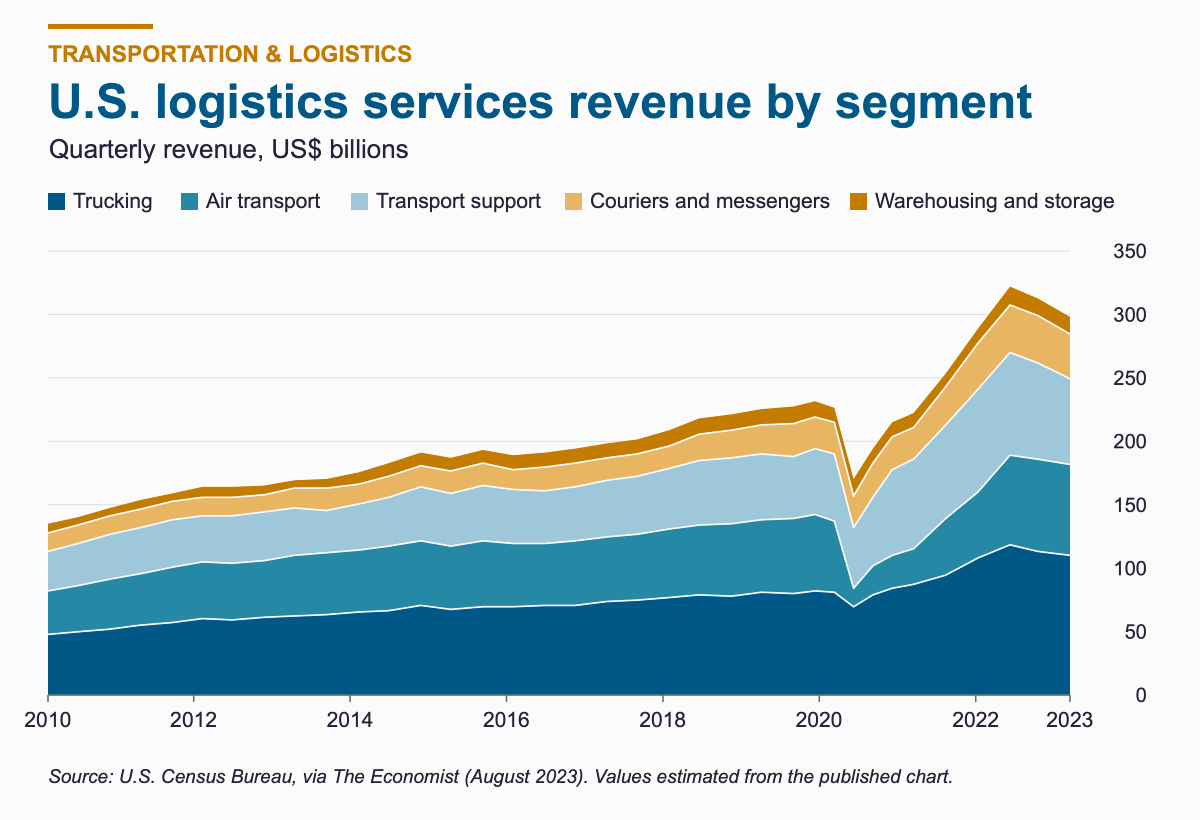
The logistics boom following the pandemic era demonstrates the risks associated with this disconnect. Between early 2020 and mid-2022, revenues in the U.S. logistics industry increased by roughly a third, prompting firms to hire one million workers and build 1.8 billion square feet of new storage space. Consumer spending shifted, causing demand to weaken, revenues to decline, and logistics providers to scale back investments. Anticipating changes in customer demand is particularly important in automotive logistics, where providers must make long-term investments in specialized equipment and infrastructure.
Why Automotive Manufacturers and Logistics Providers Need Collaboration
Extensive collaboration already exists between automotive manufacturers and their transportation and logistics partners as part of the normal course of operating and optimizing supply chain performance. Still, new vehicle designs and technology introduction can create transportation and handling requirements that are not fully understood until vehicles enter the distribution network, or at least until detailed requirements planning begins.
The issue is that transportation and logistics partners often plan long-term, strategic infrastructure investments to help them win future business with automotive manufacturers. Major contracts can often cover up to a decade of service and run into the billions of dollars. Given how quickly market conditions can change (see chart), long-term investments should be based on the best available information.
Independent market research can complement existing supply chain collaboration activities. For example, we recommend focus groups and in-depth interviews. Focus groups help identify shared, recurring operational challenges, as well as emerging requirements and perceptions of proposed solutions. In-depth interviews with logistics executives and technical specialists, on the other hand, can uncover infrastructure constraints, emerging requirements, and potential cost implications. These methods, when combined with practical vehicle testing, help automotive manufacturers identify opportunities to improve transportation compatibility and prepare logistics partners for new vehicle introductions.
Volkswagen’s $1.6 billion logistics bottleneck
In 2023, Volkswagen Group faced a major transportation bottleneck in Mexico that left approximately 53,000 finished vehicles, representing $1.6 billion in inventory, awaiting distribution. Contributing to the disruption were shortages of railway cars, trucking capacity, and port congestion.
In response, Volkswagen Group undertook a major reorganization of its North American vehicle logistics operations. Operations that were previously managed separately were reorganized and combined, establishing a new regional coordination model. By uniting the supply chain operations of Mexico, the United States, and Canada, Volkswagen Group was able to standardize key performance indicators and streamline operations for globally optimized conditions.
We can’t establish the impact of a negligible, by comparison to the cost of the disruption—investment in market research might have had on Volkswagen’s bottleneck. However, as we mentioned earlier, long-term strategic decisions should be equipped with the best information possible. We do know that transportation capacity constraints can disrupt automotive distribution, cause significant losses, and force manufacturers and logistics providers to make decisions with long-term implications hastily as the Volkswagen case illustrates.
Anticipate change. Identify opportunities. Make better decisions.
The automotive manufacturing industry and transportation and logistics industries are deeply interconnected and are invested in one another’s success. Logistics providers deliver the critical capabilities that the automotive industry depends on to support both production and distribution. In turn, logistics providers depend on automotive customers to supply critical information needed to support changing requirements, such as visibility into new product introduction pipelines, planned production volumes, and forecasts of future demand.
Even the highly sophisticated supply chain operations of the automotive and transportation and logistics industries can face costly disruptions. Uncertainty cannot be eliminated even for world-class supply chain partners that are empowered for intensely close collaboration. When business leaders face long-term strategic investments around transportation equipment, emerging technologies, and swiftly changing requirements, reliable market research is particularly valuable
For transportation and logistics providers, these insights inform new service development, strengthen competitive proposals, and help prioritize investments that will remain aligned with the speed of automotive customers.
SIS International Research brings more than 40 years of market research and strategy consulting experience to its work supporting market leaders with the intelligence and insights they need to anticipate change, identify opportunities, and make better business decisions.
Sources:
- The Economist. America’s logistics boom has turned to bust. August 2023.
- Wallenius Wilhelmsen. Wallenius Wilhelmsen solidifies collaboration with long-term automotive partner. March 2025.
- Automotive Logistics. FVL NA 2025: Get ready to re-imagine logistics — Creating a faster, agile, more competitive vehicle supply chain. April 2025.