Menu-based Conjoint Analysis
Menu-based conjoint analysis is a quantitative research method that helps businesses model consumer decision-making and preferences across complex menu-based environments.
Traditional conjoint analysis
Traditional conjoint analysis was first defined in 1964, originating from mathematical psychology and the foundational work of Duncan Luce and John Tukey. It began being applied to market research in the 1970s, followed by seminal business applications being discussed in 1975 by the Harvard Business Review.
In traditional conjoint analysis, sometimes called full-profile or ratings/rankings-based conjoint, respondents were shown multiple product attributes and asked to rate or rank them on a scale of 1-10. The method was found to be highly effective at determining what consumers want in a product or service and what they consider during purchase decisions.
Since its introduction in market research six decades ago, the statistical methods of conjoint analysis have evolved significantly.
- 1960s-1970s. Models relied on non-metric and linear regression to convert ratings and rankings.
- 1980s-1990s. Computers began assisting researchers as they shifted to Discrete Choice Experiments using Multinomial Logit models. This enabled researchers to estimate consumer preferences and actual behavior by using rating scales for competing configurations.
- 1990s-Present. Conjoint analysis was revolutionized by the introduction of Hierarchical Bayes estimation, which enabled precise estimation of individual-level utilities from discrete choices. Coupled with Latent Class Modeling, this allowed marketers to use preference patterns to discern market segmentation.
There are several types of conjoint analysis in use today. The first is Choice-Based Conjoint, an industry standard used to design a portfolio of fixed product choices, where consumers select the product their preferred product from a set of predetermined alternatives. Another type is Menu-Based Conjoint, which allows respondents (e.g., consumers) to assemble customized products or services by selecting multiple options from a menu. Other types of conjoint analysis not covered in detail here include Adaptive Choice-Based Conjoint (ACBC) and Adaptive Conjoint with MaxDiff.
Now that we understand traditional conjoint analysis, its evolution, and types in use today, let’s look more closely at Menu-Based Conjoint, as it is well suited to the recent rise in consumer preference for mass customization.
What is menu-based conjoint analysis?
Menu-based conjoint (MBC) analysis is an advanced quantitative market research technique, a conjoint-based method that is ideally suited to markets where purchase choice is based on a menu of options. The technique allows marketers to evaluate multiple consumer decisions simultaneously in order to determine the best combination of features in situations where consumers “create” their own product or service bundles.
MBC differs from traditional Choice-Based Conjoint (CBC). Whereas CBC typically asks participants to select between a range of predetermined choices, MBC allows for the selection of multiple features or service offerings from a menu. Their selections can show companies which options customers prefer, how they combine options, and how pricing influences decision-making.
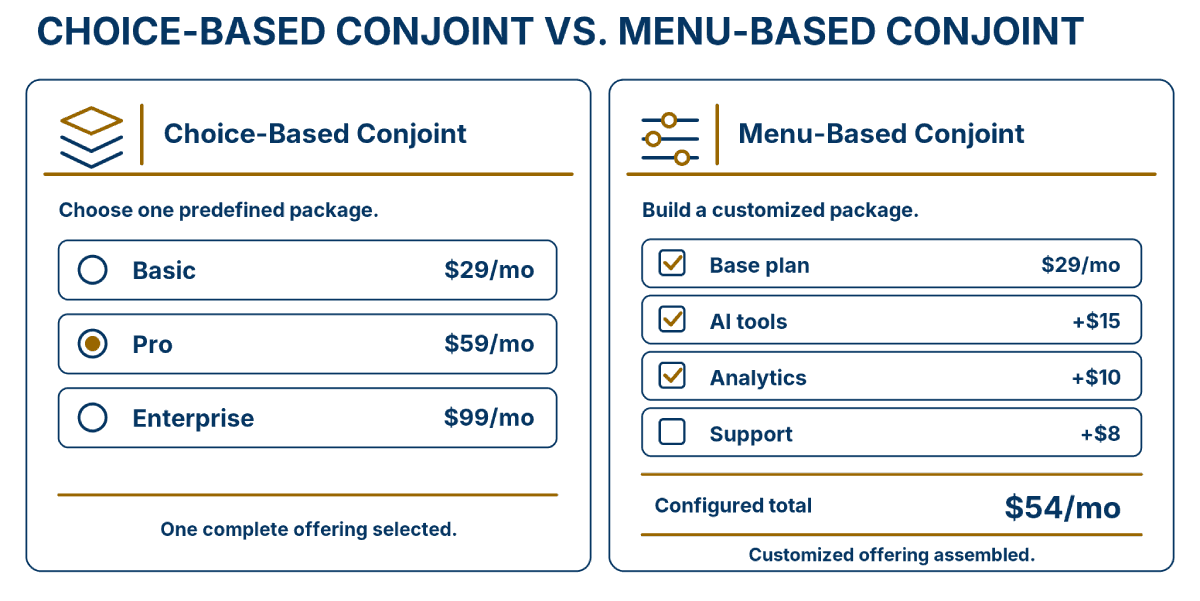
Choice-Based Conjoint (CBC) vs. Menu-Based Conjoint (MBC) Comparison
How is MBC used?
MBC simulates the decision-making process for choosing customized products or services, especially when individual options have specific prices and may or may not be available. It is used across both B2B and B2C industries such as Fast Food and Restaurants, Consumer Technology (e.g., computers), Telecom, Travel, Transportation, Banking/Finance, and Media and entertainment.
For example, a software company could use MBC to evaluate how enterprise customers configure subscriptions by selecting different combinations of features, support levels, and AI capabilities. Similarly, an automotive manufacturer could assess demand for optional equipment packages, while a telecommunications provider could evaluate combinations of data plans and additional services.
MBC is ideal at helping business leaders answer important 3 questions, such as:
- What combination of products, pricing, features, or services is most likely to increase conversion rates or maximize revenue?
- What is the ideal number of item combinations to offer to different market segments?
- What options complement or compete with one another?
Advantages and disadvantages of MBC
MBC is exceptional at providing highly realistic simulations of modern, real-world customizable purchasing environments. It can capture cross-effects, price elasticities, and natural substitution patterns between options, particularly when participants can develop their own ideal configurations. This type of nuanced behavioral data provides a basis for making more detailed financial forecasts and enables teams to confidently project revenue impact, feature attach rates, and average basket sizes.
However, these modeling capabilities are not without disadvantages. They also carry significantly greater technological burdens on the backend (MBC service provider teams) and place greater demands on participants. For example, presenting multi-choice decision screens creates substantially more cognitive fatigue for respondents, which can degrade data quality if not correctly designed.
Looking ahead
The future of MBC
MBC is unlikely to disappear because the purchasing decisions it models are not only becoming more complex, but also more common. As use of menu-based choices increases, the usefulness of MBC increases, as does the likelihood of its application to market research, all of which translates into growing demand for the service.
What is likely is that MBC analysis will evolve, underpinned by the adoption of technologies which make the creation and delivery of MBC studies less cumbersome to design, easier to run, and all at reduced cost. A few key trends shaping the future of MBC are the rise of dynamic and adaptive menus, integrations with live e-commerce, and improvements in handling more complex bundles and even higher-choice environments.
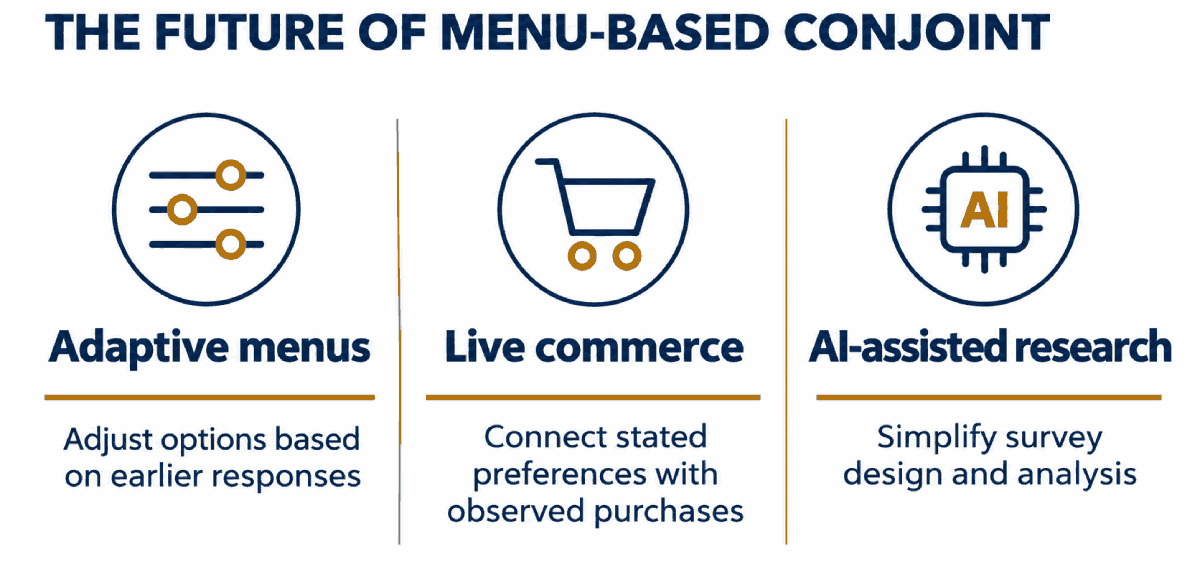
AI’s impact on MBC
Another key trend that deserves more focus is the application of AI to MBC analysis. The impact of combining traditional multi-item choice modeling with AI will improve how we design, deploy, and analyze complex product and service menus. For example, AI-assisted experimental design and item generation can use large language models (LLMs) to help researchers extract realistic menu items, attributes, and price tiers from customer interviews and sales call transcripts.
Another advancement using AI-assisted MBC is the introduction of adaptive question routing. That is, AI can be used to actively select which menu variations or price points a respondent will be shown based on their previous clicks. This promises to reduce survey fatigue while capturing even more data across massive permutations of possible combinations.
Don’t guess the combination. Research it.
Products and services are becoming increasingly customizable as consumer preference for mass customization rises and industry can manufacture configurable products at a profit. This makes understanding which combinations customers actually value even more central to product and service offering strategy.
Menu-based conjoint analysis lets businesses evaluate combinations of items, options, and pricing by simulating how consumers select products, features, and services.
The challenge is selecting the right methodology and designing research that reflects how customers make purchasing decisions.
And crucially, selecting the right service partner to manage your menu-based conjoint analysis.
At SIS International, we bring over 40 years of market research experience to help businesses develop quantitative research approaches. We have been applying conjoint analysis to marketing research since its rise in the early 1980s. Whether evaluating new product configurations, optimizing pricing strategies, or identifying opportunities to increase revenue, SIS helps companies replace assumptions with evidence-based decisions and turn complex customer preferences into actionable intelligence
Contact SIS International Research to explore how menu-based conjoint analysis can inform your product and pricing strategy.
Sources:
- Journal of Mathematical Psychology. Simultaneous conjoint measurement: A new type of fundamental measurement. January 1964.
https://www.sciencedirect.com/science/article/abs/pii/002224966490015X?via%3Dihub - Journal of Market Research. Conjoint Measurement for Quantifying Judgmental Data. August 1971.
https://journals.sagepub.com/doi/10.1177/002224377100800312 - Harvard Business Review. New way to measure consumers’ judgements. July 1975
https://hbr.org/1975/07/new-way-to-measure-consumers-judgments - Arxiv. From Prompts to Preferences: An Open-Source Platform for Generative AI-Enhanced Conjoint Analysis. June 2026
https://arxiv.org/abs/2606.12972