B2B Market Research Strategies and TechniquesRuth Stanat2026-11-03T23:55:19-05:00B2B Market Research Strategies and Techniques

By employing targeted B2B market research strategies, organizations can better understand their audience, refine their offerings, and secure long-term success.
B2B Market Research Strategies offer insights that guide strategic decisions and shape business development – and by employing effective market research strategies, companies can gain a deeper understanding of their target audience, identify emerging opportunities, and refine their offerings to better meet client demands.
What Are B2B Market Research Strategies?
B2B market research strategies gather, analyze, and apply insights about their target markets, industries, and competitors. These strategies are tailored to the unique dynamics of business-to-business environments, where decision-making processes, buyer behavior, and market demands differ significantly from consumer markets.
Effective B2B market research strategies help organizations answer key questions such as:
- Who are our target customers, and what are their specific needs?
- What are the emerging trends and challenges in our industry?
- How do our offerings compare to competitors in the market?
Why Do Businesses Need B2B Market Research Strategies?
B2B market research strategies and techniques empower organizations to navigate industry complexities, understand customer needs, and stay ahead of the competition. Here’s why these strategies are essential:
Addressing Complex Decision-Making
B2B transactions often involve multiple stakeholders, longer buying cycles, and higher-value contracts than B2C markets. A well-structured market research strategy helps businesses understand:
- The roles and priorities of decision-makers.
- The stages of the buyer’s journey.
- Factors that influence purchasing decisions, such as budget constraints and operational goals.
Staying Ahead of Market Trends
Industries constantly evolve, driven by technological advancements, regulatory changes, and shifting customer demands. B2B market research strategies enable businesses to anticipate these changes by identifying:
- Emerging trends and technologies.
- New customer expectations.
- Potential threats from disruptive competitors or innovations.
Enhancing Product and Service Offerings
B2B market research strategies and techniques provide invaluable feedback on product performance and customer satisfaction. By analyzing this data, businesses can:
- Refine existing products or services to better meet customer needs.
- Identify opportunities for innovation and new product development.
- Test concepts or features before launching to reduce risk.
Optimizing Marketing and Sales Strategies
Effective communication is crucial in B2B markets, where decisions are driven by logic and data. Market research strategies help businesses:
- Understand the channels and messaging that resonate with their audience.
- Segment their target market for personalized outreach.
- Develop value propositions that address specific pain points.
Mitigating Risks and Maximizing ROI
Entering a new market or launching a product involves inherent risks. B2B market research strategies and techniques minimize uncertainty by providing:
- Accurate demand forecasts.
- Detailed competitor analyses.
- Insights into potential barriers, such as regulatory hurdles or cultural differences.
Defining Objectives for B2B Market Research
Setting well-defined goals ensures the research process is focused and aligned with your business needs. Objectives should address specific questions such as: What key insights are we seeking? How will these insights impact our business strategy?
Establishing clear objectives helps design research that targets relevant data and avoids unnecessary complexity. For instance, if the goal is to understand the buying behavior of key accounts, your research should be tailored to uncovering factors influencing purchase decisions rather than general market trends.
Essential B2B Market Research Strategies and Techniques
| Strategy | Description | Key Benefits | Source |
|---|
| Customer Surveys | Structured questionnaires to gather direct feedback from target customers about needs, preferences, and pain points | Cost-effective, scalable data collection with quantifiable results | SurveyMonkey Business Guide |
| In-Depth Interviews | One-on-one conversations with key stakeholders to explore complex business challenges and decision-making processes | Rich qualitative insights, understanding of motivations and barriers | Forrester Research |
| Focus Groups | Moderated group discussions with 6-12 participants to explore attitudes and perceptions about products or services | Group dynamics reveal deeper insights, cost-effective per participant | Qualtrics Research |
| Competitive Analysis | Systematic evaluation of competitors’ strategies, pricing, positioning, and market share | Identifies market gaps, benchmarks performance, informs strategic positioning | HubSpot Marketing |
| Market Segmentation | Dividing the market into distinct groups based on demographics, behavior, needs, or characteristics | Targeted messaging, improved ROI, personalized customer experience | McKinsey & Company |
| Industry Reports | Comprehensive analysis of market trends, size, growth projections, and key players within specific industries | Market context, trend identification, investment decision support | Grand View Research |
| Digital Analytics | Analysis of website traffic, user behavior, and digital engagement patterns to understand customer journeys | Real-time data, behavioral insights, optimization opportunities | Google Analytics Insights |
| Social Media Listening | Monitoring social platforms for brand mentions, industry conversations, and customer sentiment | Real-time market pulse, brand perception, emerging trends identification | Sprout Social |
| Customer Journey Mapping | Visual representation of the customer’s experience across all touchpoints and interactions | Identifies pain points, optimizes experience, improves conversion rates | Salesforce |
| Ethnographic Research | Observational research conducted in natural business environments to understand real-world behaviors | Unbiased insights, contextual understanding, innovation opportunities | Nielsen Norman Group |
Identifying and Understanding Your Target Audience
A critical B2B Market Research Strategies component is identifying and thoroughly understanding your target audience. This involves segmenting your market into distinct groups based on various criteria such as industry, company size, geographic location, and decision-makers’ roles. Understanding these segments allows for more precise and relevant research that addresses each group’s unique needs and preferences.
Effective audience profiling involves gathering detailed insights into your target business clients. Techniques such as surveys, interviews, and focus groups can help uncover important information about your audience’s challenges, preferences, and decision-making processes.
Choosing the Right Research Methodologies

The choice of methods impacts the quality and relevance of the data collected, and should align with your research objectives and target audience. Here are key methodologies to consider:
- Surveys: Surveys are useful for gathering quantitative data from a large audience. Surveys can be distributed online, via phone, or through face-to-face interactions. They are effective for measuring attitudes, behaviors, and trends.
- Interviews: Interviews provide in-depth qualitative insights through one-on-one discussions. Interviews are ideal for exploring complex topics and understanding individual perspectives.
- Focus Groups: Focus groups facilitate group discussions to gain qualitative insights into opinions, attitudes, and perceptions. They can reveal detailed feedback and foster interactive dialogue among participants.
- Data Analytics: Data analytics involve analyzing existing data sources to identify trends and patterns. This method leverages big data and advanced analytics tools to derive actionable insights.
Leveraging Data Analytics and Technology
By harnessing advanced tools and techniques, businesses can analyze vast amounts of data to uncover actionable insights and maintain a competitive edge. Here’s how data analytics and technology can be leveraged effectively:
- Advanced Analytics Tools offer statistical analysis, predictive modeling, and data visualization. They help interpret complex data sets and forecast future trends.
- Customer Relationship Management (CRM) Systems help businesses gain insights into customer behavior, purchase history, and interaction patterns. They help understand client needs and improve customer engagement.
- Data Mining assists in extracting valuable patterns and relationships from large datasets. This can reveal hidden trends and inform strategic decisions.
Implementing Effective B2B Market Research Strategies
Executing your B2B Market Research Strategies effectively requires careful planning and execution – and here are best practices to ensure that your research is successful and the findings are actionable:
- Develop a Research Plan: Create a detailed plan outlining your research objectives, methodologies, timelines, and resources.
- Ensure Data Collection Accuracy: Implement quality control measures to ensure that the data collected is accurate and reliable.
- Engage Stakeholders: Involve key stakeholders throughout the research process to ensure the research addresses their needs and expectations. Regular updates and feedback sessions can help align the research with business objectives.
- Monitor Progress: Track the progress of your research to ensure it stays on schedule and within budget. Adjustments may be needed if unforeseen issues arise or the research scope changes.
- Integrate Findings into Business Planning: Ensure that the insights gained from the research are effectively integrated into strategic planning and decision-making processes. Use the findings to inform product development, marketing strategies, and sales approaches.
Methods for Effective B2B Market Research Strategies and Techniques
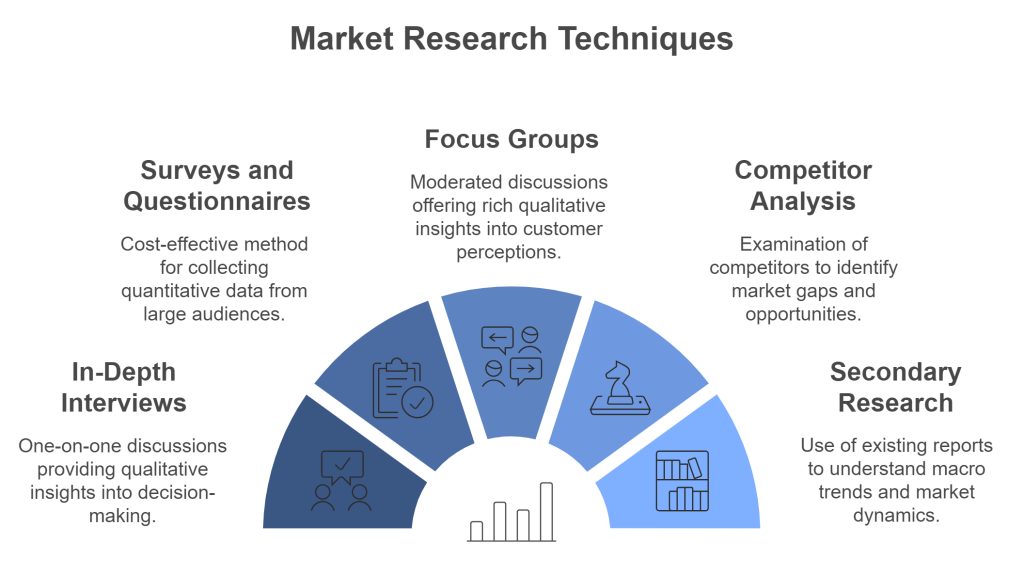
B2B market research strategies rely on these techniques to build robust B2B market research strategies:
1. In-Depth Interviews
One-on-one interviews with key decision-makers and industry experts provide qualitative insights beyond surface-level data. These discussions uncover pain points, expectations, and priorities influencing purchasing decisions.
2. Surveys and Questionnaires
Surveys are a cost-effective way to collect quantitative data from a large audience. They are ideal for identifying trends, measuring satisfaction, and validating hypotheses.
3. Focus Groups
Focus groups bring together select participants to discuss specific topics in a moderated setting. These sessions provide rich qualitative insights into customer perceptions, preferences, and expectations.
4. Competitor Analysis
This technique involves analyzing competitors’ strengths, weaknesses, pricing strategies, and customer experiences to identify gaps and opportunities in the market.
5. Secondary Research
Using existing reports, studies, and industry publications provides a cost-effective way to gather insights. Secondary research helps businesses understand macro trends, market dynamics, and regulatory changes without conducting primary research.
Our Insights and Recommendations for Effective B2B Market Research Strategies
At SIS International, we believe that the success of any market research initiative lies in crafting tailored strategies that align with a company’s goals and market dynamics.
We recommend using a combination of qualitative and quantitative methods to achieve a comprehensive understanding of your market. While interviews and focus groups provide deep insights into customer needs and behaviors, surveys and analytics offer measurable data that validates these findings. Furthermore, we consider it essential to align your B2B market research strategies with sector-specific trends, such as sustainability in energy, digital transformation in manufacturing, or customer personalization in technology.
Analyzing and Interpreting Data
This phase transforms raw data into meaningful information that can guide decision-making. Here’s how to effectively analyze and interpret your data:
- Data Cleaning: Clean your data to remove inaccuracies, duplicates, or incomplete entries.
- Statistical Analysis: Use statistical techniques to identify patterns, correlations, and trends within the data.
- Data Visualization: Create charts, graphs, and dashboards to represent your data visually.
- Cross-Tabulation: Analyze relationships between different variables by cross-tabulating data.
- Insight Generation: Translate the results of your analysis into actionable insights.
What Makes SIS International a Leader in B2B Market Research Strategies?
SIS International is a globally renowned provider of market research services, specializing in crafting and executing effective B2B market research strategies. With 40 decades of experience and an innovative approach, SIS is committed to delivering actionable insights that empower businesses to thrive in competitive markets.
Tailored Research Solutions
SIS International understands that every business is unique, and its market research strategies reflect that. Our team customizes its research approach to align with clients’ specific goals, industries, and target markets, ensuring every insight is relevant and actionable.
Global Expertise with Local Insights
SIS combines global reach with localized knowledge across North America, Europe, Asia, and beyond. Our researchers are deeply attuned to regional trends and cultural nuances, providing businesses with a comprehensive understanding of their target markets.
Innovative Research Techniques
We employ traditional and cutting-edge research methodologies, including in-depth interviews, advanced analytics, focus groups, and digital monitoring tools. These techniques ensure a balanced and robust perspective on market dynamics.
Proven Track Record
With a history of successful partnerships with Fortune 500 companies and industry leaders, SIS has earned its reputation as a trusted advisor. Our expertise spans diverse industries, including technology, healthcare, energy, and professional services.
Focus on Emerging Trends
SIS International stays ahead of industry shifts, ensuring its clients benefit from the latest insights into sustainability, digital transformation, customer retention, and innovation. This proactive approach helps businesses remain agile and competitive.
Our Facility Location in New York
11 E 22nd Street, Floor 2, New York, NY 10010 T: +1(212) 505-6805
About SIS International
SIS International offers Quantitative, Qualitative, and Strategy Research. We provide data, tools, strategies, reports, and insights for decision-making. We also conduct interviews, surveys, focus groups, and other Market Research methods and approaches. Contact us for your next Market Research project.