
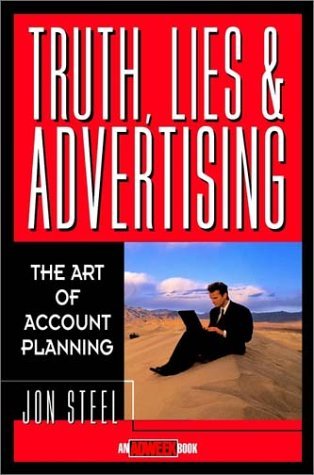
 Como parte de nuestra serie de reseñas de libros de marketing, recientemente revisamos "Verdad, mentiras y publicidad: el arte de la planificación de cuentas" de Jon Steel. Si bien se centra en la publicidad, el contenido del libro puede aplicarse a otras ramas de los servicios de marketing. En particular, estábamos ansiosos por leer su perspectiva sobre la investigación de mercado en campañas publicitarias.
El objetivo de Steel es proponer un nuevo modelo de publicidad basado en la complejidad de las personas y sus emociones. El modelo incorpora una asociación de partes interesadas en una campaña publicitaria:
- perspectiva empresarial del cliente
- perspectiva creativa de la agencia
- opinions and prejudices of the people at whom advertising is aimed; In other words, the consumer needs to be probed for insecurities, motivations, habits, and prejudices
Al “triangular” estas perspectivas, uno se acerca más a la verdad. Detrás de este modelo está su aprecio por el caos. La justificación de Steel es que la suma del todo es mayor que las partes individuales. Por el contrario, si se permite que domine una perspectiva, la calidad y eficacia de una campaña publicitaria pueden verse afectadas. El caos, indica Steel, puede ser útil para ofrecer el mejor trabajo a los clientes.
- Entorno que afecta la investigación sobre publicidad
- ¿En qué estado de ánimo los pone?
- Oportunidad (debe fomentarse)
Steel continúa estableciendo un paralelo inesperado entre la física cuántica y la publicidad, en referencia al caos. En última instancia, Steel implica que el caos y el deseo de perspectivas conflictivas en la Física Cuántica es similar a su enfoque de perspectivas diversas.
Steel continues to define Advertising according to Jeff Goodby’s definition: getting into one’s mind and changing one’s mind, but not telling one how to think. Along these lines, Steel asserts that Advertising cannot sell something; instead it influences the mind, which can influence purchasing.
So is advertising art or business? Goodby stated that Advertising was the Business of Changing Minds. Hence, it appears that Advertising is a mix of art and commerce, leaning toward commerce. Conceiving Advertising mostly as an art is problematic as it raises the problem of putting the interests of the creative above those of the client’s. Steel implies that Advertisers need to realize that the objective of their clients is to sell products or ideas.
Además, ¿la publicidad es una ciencia o un arte? Steel afirma que la publicidad no es una ciencia porque ignora la complejidad de las emociones humanas. La ciencia supone que se pueden descomponer los componentes y reconstruir cosas según el modelo de máquina de Margaret Wheatley. Según Steel, datos demasiado científicos pueden centrarse en los árboles y descuidar el bosque.
Steel writes about the power of the unscientific method. He cites evidence that some of the best brains, including Einstein, Oppenheimer (a physicist), and Watson/Crick, deviated from the scientific method by combining science and art (intuition, fantasy). Steel implies that this occurred because these great thinkers realized that the scientific method could not explain everything.
Contextually, advertising faces several problems in reaching consumers. Advertising is directed at people, and tries to tell them what to do. Messages have been overused. Consequently, people dislike advertising. Steel proposes that the Holy Trinity in Advertising consists of:
- sencillez
- sentido común
- creatividad
Ideas sobre la investigación
Steel asserts that clients assume that those on the outside share their same amount of knowledge, and that it was the role of the planner needs to change this. He indicates that the focus group moderator should have the power to introduce a completely new idea and deviate from the discussion guide. For example, he worked on a project on “Disability Insurance,” which by itself is a word that makes people shudder. Exploratory research was employed to allow the respondent to freely think and speak her thoughts. He found that respondents considered disability insurance as a necessary evil. As a result, the resulting ad campaign focused on the wide picture of the future and the realities that would impact some of the population. The message was that the company had your interests at heart.
Steel also claims that researchers need to look at what is not being said. Citing the example of a project for KPMG Peat Marwick, he had conducted many interviews with high-level executives. All research interviews consisted of the respondent telling the interviewer that what they were saying was all confidential. Hence, he came up with the idea to make a slogan conveying the exciting, stealthy, and confidential nature of what KPMG did.
Ultimately, the book has invigorating examples of creative advertisements. Its easy-to-read writing style is consistent with his overall theories on simplicity and common sense in advertising. Its theories on advertising campaign are helpful in conceptualizing the most effective advertising campaign. Our only displeasure was that its ideas on research did not add much in value from other authors in the genre, such as Clotaire Rapaille author of the “Culture Code.


 ES
ES  EN
EN  AR
AR  ZH
ZH  ZH_HK
ZH_HK  NL
NL  FR
FR  DE
DE  IT
IT  JA
JA  KO
KO  PL
PL  PT
PT