
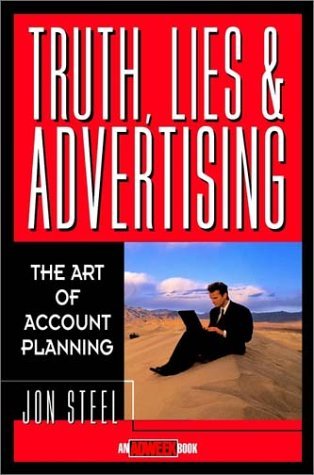
 Dans le cadre de notre série de critiques de livres de marketing, nous avons récemment examiné « Truth, Lies and Advertising : the Art of Account Planning » de Jon Steel. Bien qu'il soit axé sur la publicité, le contenu du livre peut facilement être appliqué à d'autres branches des services marketing. Nous étions particulièrement impatients de lire son point de vue sur les études de marché dans les campagnes publicitaires.
L'objectif de Steel est de proposer un nouveau modèle de publicité basé sur la complexité des personnes et de leurs émotions. Le modèle intègre un partenariat de parties prenantes dans une campagne publicitaire :
- le point de vue commercial du client
- le point de vue créatif de l'agence
- opinions and prejudices of the people at whom advertising is aimed; In other words, the consumer needs to be probed for insecurities, motivations, habits, and prejudices
En « triangulant » ces perspectives, on en parvient à se rapprocher de la vérité. Ce modèle repose sur une appréciation du chaos. La justification de l'acier est que la somme du tout est supérieure aux parties individuelles. À l’inverse, si une perspective domine, la qualité et l’efficacité d’une campagne publicitaire peuvent en souffrir. Le chaos, indique Steel, peut être utile pour fournir le meilleur travail aux clients.
- Environnement affectant la recherche sur la publicité
- Dans quel genre d’humeur cela les met-il ?
- Chance (devrait être encouragée)
Steel poursuit en établissant un parallèle inattendu entre la physique quantique et la publicité, en référence au chaos. En fin de compte, Steel laisse entendre que le chaos et le désir de perspectives contradictoires en physique quantique sont similaires à son approche des perspectives diverses.
Steel continues to define Advertising according to Jeff Goodby’s definition: getting into one’s mind and changing one’s mind, but not telling one how to think. Along these lines, Steel asserts that Advertising cannot sell something; instead it influences the mind, which can influence purchasing.
So is advertising art or business? Goodby stated that Advertising was the Business of Changing Minds. Hence, it appears that Advertising is a mix of art and commerce, leaning toward commerce. Conceiving Advertising mostly as an art is problematic as it raises the problem of putting the interests of the creative above those of the client’s. Steel implies that Advertisers need to realize that the objective of their clients is to sell products or ideas.
Par ailleurs, la publicité est-elle une science ou un art ? Steel affirme que la publicité n’est pas une science car elle néglige la complexité des émotions humaines. La science suppose que l’on peut démonter les composants et reconstruire les choses selon le modèle de machine de Margaret Wheatley. Des données trop scientifiques peuvent, selon Steel, se concentrer sur les arbres et négliger la forêt.
Steel writes about the power of the unscientific method. He cites evidence that some of the best brains, including Einstein, Oppenheimer (a physicist), and Watson/Crick, deviated from the scientific method by combining science and art (intuition, fantasy). Steel implies that this occurred because these great thinkers realized that the scientific method could not explain everything.
Contextually, advertising faces several problems in reaching consumers. Advertising is directed at people, and tries to tell them what to do. Messages have been overused. Consequently, people dislike advertising. Steel proposes that the Holy Trinity in Advertising consists of:
- simplicité
- bon sens
- la créativité
Idées sur la recherche
Steel asserts that clients assume that those on the outside share their same amount of knowledge, and that it was the role of the planner needs to change this. He indicates that the focus group moderator should have the power to introduce a completely new idea and deviate from the discussion guide. For example, he worked on a project on “Disability Insurance,” which by itself is a word that makes people shudder. Exploratory research was employed to allow the respondent to freely think and speak her thoughts. He found that respondents considered disability insurance as a necessary evil. As a result, the resulting ad campaign focused on the wide picture of the future and the realities that would impact some of the population. The message was that the company had your interests at heart.
Steel also claims that researchers need to look at what is not being said. Citing the example of a project for KPMG Peat Marwick, he had conducted many interviews with high-level executives. All research interviews consisted of the respondent telling the interviewer that what they were saying was all confidential. Hence, he came up with the idea to make a slogan conveying the exciting, stealthy, and confidential nature of what KPMG did.
Ultimately, the book has invigorating examples of creative advertisements. Its easy-to-read writing style is consistent with his overall theories on simplicity and common sense in advertising. Its theories on advertising campaign are helpful in conceptualizing the most effective advertising campaign. Our only displeasure was that its ideas on research did not add much in value from other authors in the genre, such as Clotaire Rapaille author of the “Culture Code.


 FR
FR  EN
EN  AR
AR  ZH
ZH  ZH_HK
ZH_HK  NL
NL  DE
DE  IT
IT  JA
JA  KO
KO  PL
PL  PT
PT  ES
ES