
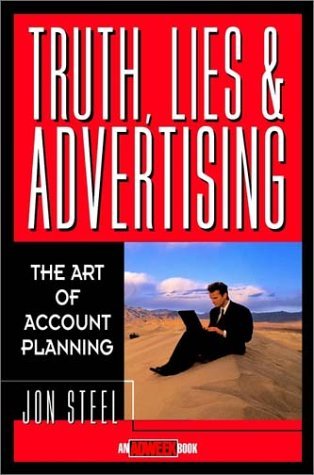
 作为我们营销书评系列的一部分,我们最近评论了 Jon Steel 的《真相、谎言和广告:客户规划的艺术》。虽然这本书的重点是广告,但其内容可以切实应用于营销服务的其他分支。特别是,我们渴望阅读它对广告活动中的市场研究的看法。
Steel 的目标是提出一种基于人及其情感的复杂性的全新广告模式。该模式将利益相关者的合作关系融入广告活动中:
- 客户的业务视角
- 机构的创意视角
- opinions and prejudices of the people at whom advertising is aimed; In other words, the consumer needs to be probed for insecurities, motivations, habits, and prejudices
在“三角测量”这些观点时,人们会更接近真相。该模型的基础是对混乱的欣赏。斯蒂尔的理由是,整体的总和大于各个部分。相反,如果让一种观点占主导地位,广告活动的质量和效果就会受到影响。斯蒂尔表示,混乱有助于为客户提供最好的工作。
- 影响广告研究的环境
- 这会让他们心情怎样?
- 机会(应鼓励)
Steel 进一步在混沌方面将量子物理学与广告进行了出人意料的对比。最终,Steel 暗示量子物理学中的混沌和对冲突观点的渴望与他对多元化观点的态度相似。
Steel continues to define Advertising according to Jeff Goodby’s definition: getting into one’s mind and changing one’s mind, but not telling one how to think. Along these lines, Steel asserts that Advertising cannot sell something; instead it influences the mind, which can influence purchasing.
So is advertising art or business? Goodby stated that Advertising was the Business of Changing Minds. Hence, it appears that Advertising is a mix of art and commerce, leaning toward commerce. Conceiving Advertising mostly as an art is problematic as it raises the problem of putting the interests of the creative above those of the client’s. Steel implies that Advertisers need to realize that the objective of their clients is to sell products or ideas.
此外,广告是一门科学还是一门艺术?斯蒂尔指出,广告不是一门科学,因为它忽视了人类情感的复杂性。科学假设你可以分解组件并根据玛格丽特·惠特利的机器模型重建事物。斯蒂尔认为,过于科学的数据可能会只顾树木而忽视森林。
Steel writes about the power of the unscientific method. He cites evidence that some of the best brains, including Einstein, Oppenheimer (a physicist), and Watson/Crick, deviated from the scientific method by combining science and art (intuition, fantasy). Steel implies that this occurred because these great thinkers realized that the scientific method could not explain everything.
Contextually, advertising faces several problems in reaching consumers. Advertising is directed at people, and tries to tell them what to do. Messages have been overused. Consequently, people dislike advertising. Steel proposes that the Holy Trinity in Advertising consists of:
- 简单
- 常识
- 创造力
研究思路
Steel asserts that clients assume that those on the outside share their same amount of knowledge, and that it was the role of the planner needs to change this. He indicates that the focus group moderator should have the power to introduce a completely new idea and deviate from the discussion guide. For example, he worked on a project on “Disability Insurance,” which by itself is a word that makes people shudder. Exploratory research was employed to allow the respondent to freely think and speak her thoughts. He found that respondents considered disability insurance as a necessary evil. As a result, the resulting ad campaign focused on the wide picture of the future and the realities that would impact some of the population. The message was that the company had your interests at heart.
Steel also claims that researchers need to look at what is not being said. Citing the example of a project for KPMG Peat Marwick, he had conducted many interviews with high-level executives. All research interviews consisted of the respondent telling the interviewer that what they were saying was all confidential. Hence, he came up with the idea to make a slogan conveying the exciting, stealthy, and confidential nature of what KPMG did.
Ultimately, the book has invigorating examples of creative advertisements. Its easy-to-read writing style is consistent with his overall theories on simplicity and common sense in advertising. Its theories on advertising campaign are helpful in conceptualizing the most effective advertising campaign. Our only displeasure was that its ideas on research did not add much in value from other authors in the genre, such as Clotaire Rapaille author of the “Culture Code.


 ZH
ZH  EN
EN  AR
AR  ZH_HK
ZH_HK  NL
NL  FR
FR  DE
DE  IT
IT  JA
JA  KO
KO  PL
PL  PT
PT  ES
ES