
Recherche B2B
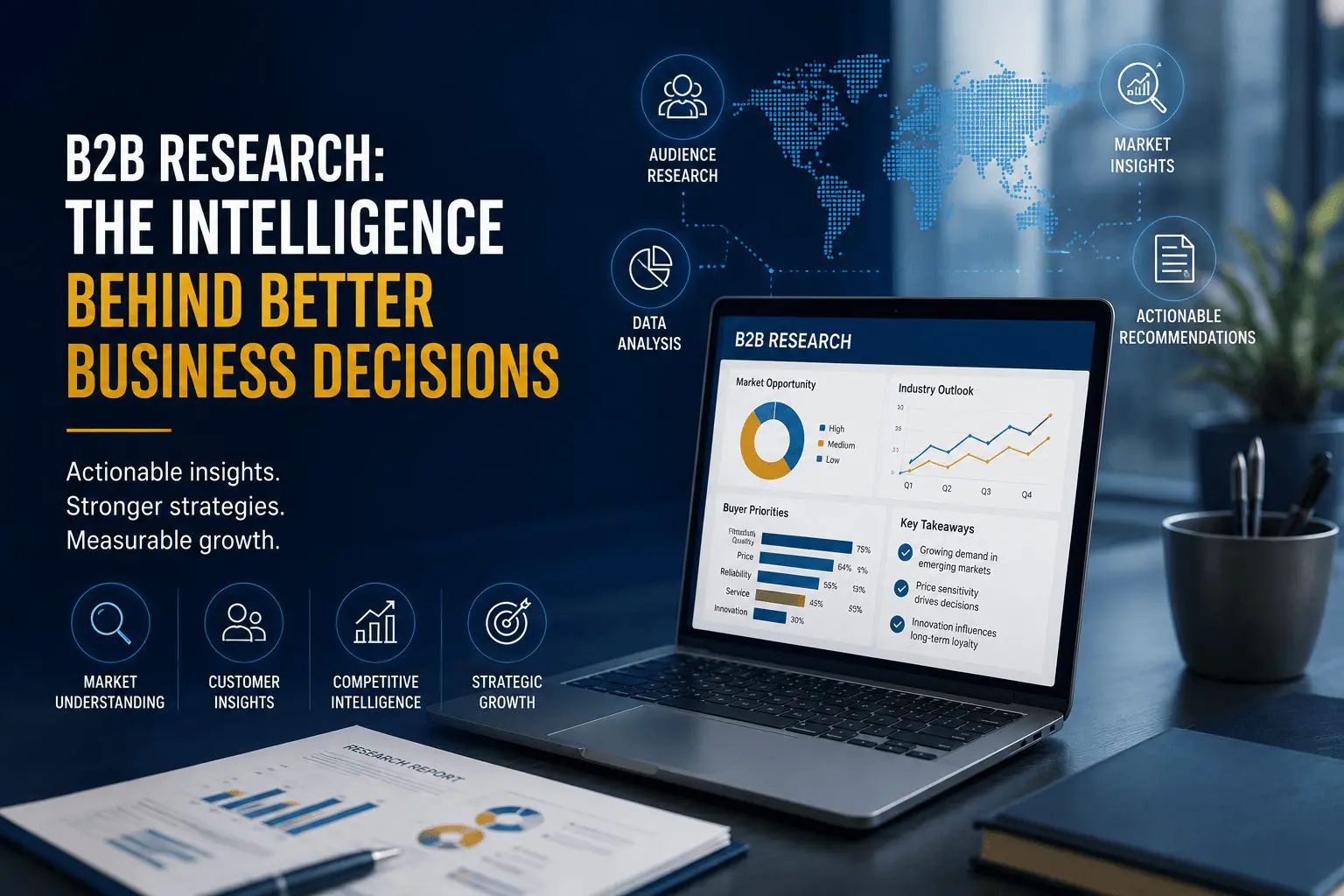
B2B research operates in a completely different universe. You are not studying someone deciding which coffee to buy at the grocery store. You are analyzing multi-person committees making six-figure decisions that could get them promoted or fired. The stakes are higher, the timelines longer, and the psychology infinitely more complex.
Ttable des matières
Why B2B Research Is Not Like Consumer Research
Stop thinking of B2B research as “getting feedback.” Start thinking of it as intelligence gathering that transforms how you compete.
When you conduct proper B2B research, you are diving into organizational dynamics that consumer studies never touch. Who influences the decision versus who signs the contract? What happens in those internal meetings you’re never invited to? Which concerns get voiced during evaluations, and which ones kill deals silently? This complexity requires research methodologies designed specifically for business environments, not adapted from consumer playbooks.
Why B2B Research Now Defines SaaS Category Leadership
Enterprise software buying committees have expanded. Procurement, security, finance, and line-of-business owners each hold veto authority and evaluate on different criteria. Research designed for a single champion no longer reflects how deals actually close.
The vendors gaining share treat b2b research as a system for mapping this committee. They run structured expert interviews with economic buyers, technical evaluators, and end users on the same account, then triangulate priorities. The output is a decision map, not a persona deck.
Decision-Maker Access: The B2B Research Challenge
Getting access to B2B decision-makers for research is brutally difficult.
These people guard their time fiercely. They are drowning in vendor pitches, internal meetings, strategic initiatives, and operational firefighting. A cold email asking for a 45-minute interview gets deleted instantly. Traditional market research approaches that work for consumers—online panels, mall intercepts, focus groups with strangers—fail spectacularly in B2B contexts.
Professional B2B research requires specialized recruitment strategies. Sometimes it’s leveraging industry conferences where decision-makers gather anyway. Other times it’s offering compelling incentives—not the $75 Amazon gift card that works for consumers, but access to exclusive industry insights, benchmark data they can’t get elsewhere, or meaningful charitable donations to causes they support.
Primary B2B Market Research Methods Used by Professionals
The Interview: B2B Research's Secret Weapon
Nothing beats one-on-one interviews for extracting genuine insights from business decision-makers.
Thirty to sixty minutes of direct conversation with a VP of Operations, a CFO, or a procurement director yields more actionable intelligence than a hundred survey responses. Why? Because skilled interviewers can probe beneath surface answers, explore contradictions, and follow unexpected conversational threads that reveal breakthrough insights.
The key is the interviewer's expertise in your specific industry. A moderator brilliant at consumer focus groups will bomb interviewing C-suite executives about enterprise software decisions. You need someone who speaks the language, understands the business context, recognizes when a polite deflection needs challenging, and knows which follow-up questions will unlock deeper truths.
Professional B2B research interviews follow a semi-structured approach—there's a discussion guide ensuring key topics get covered, but also flexibility to explore interesting tangents. The worst interviews feel like interrogations checking boxes on a form. The best feel like valuable business conversations where executives share candid perspectives because the interviewer demonstrates genuine understanding and asks intelligent questions.
Survey Design That Actually Gets B2B Responses
Most B2B surveys fail because they are designed like consumer surveys—too long, poorly focused, and treating respondents' time as worthless.
Business decision-makers will not complete 30-minute surveys about product features. They will complete eight-minute surveys that demonstrate clear value for their time investment. Every question needs justification. Every minute needs respect. If you can't explain why a question matters, cut it.
Incentives work differently in B2B research than in consumer studies. A $25 gift card motivates consumers. It insults most business executives. Better incentives include exclusive access to research results, charitable donations made in participants' names, or entry into drawings for significant prizes like conference attendance or high-value tech items. Some of the highest response rates come from surveys offering no monetary incentive but demonstrating clear industry value.
Small Sample Sizes: Working With B2B Research Limitations
SIS International's competitive intelligence work across enterprise software categories indicates that the highest-signal input is not competitor marketing but structured interviews with buyers who evaluated three or more vendors in the last twelve months. These evaluators reveal positioning gaps, objection patterns, and pricing anchors that no public source captures.
Consumer researchers work with millions of potential survey respondents. B2B researchers targeting Fortune 1000 companies or specific industry niches might have a total universe of 200 qualified decision-makers. This fundamentally changes research design, sampling strategies, and what "statistical significance" even means.
When your total addressable market is small, every response matters enormously. Losing two survey completes because your screening was too aggressive might represent 2% of your entire potential customer base. This demands different approaches—perhaps conducting 30 in-depth interviews provides more value than surveying 100 people with shallow questions.
How Professionals Conduct B2B Research
Share of research professionals who regularly use each primary method, showing how quantitative reach and qualitative depth work together in business studies
Source 1: Market Research Methods Usage Statistics
Source 2: SIS International B2B Research Overview
Technology's Role in Modern B2B Research
Online survey platforms, video conferencing, and AI-powered analytics have made certain types of B2B research faster and cheaper. You can now interview a C-suite executive in Tokyo from your office in Chicago without anyone traveling. Transcription and preliminary analysis that once took weeks happen in hours. Sentiment analysis tools can process hundreds of interview transcripts identifying patterns human analysts might miss.
But technology also creates new problems. Survey fatigue is real—business decision-makers are drowning in requests for their opinions. Automation has made it too easy to blast generic surveys to thousands of executives who delete them instantly. The result? Lower response rates requiring more aggressive recruitment tactics or higher incentives just to reach baseline participation.
Timing Your B2B Research Investment
Based on SIS International's analysis of go-to-market engagements across vertical and horizontal SaaS categories, the vendors with the strongest expansion economics run quarterly voice-of-customer programs segmented by cohort maturity, not by ARR band. Early cohorts reveal onboarding friction. Mature cohorts reveal expansion barriers. Aggregated VOC misses both.
The most valuable B2B research happens early when you can still change course without massive sunk costs. Before developing new products, before launching rebranding initiatives, before entering new markets, before restructuring your sales organization. Research conducted to validate decisions already made wastes money and sets up your team for cognitive dissonance when findings contradict assumptions.
But timing also means recognizing when you need research versus when you need action. If you're in a fast-moving market where competitors are gaining ground, spending six months on comprehensive B2B research while they capture market share is strategic malpractice. Sometimes you need quick directional insights to make decent decisions now rather than perfect insights that arrive too late.
Common B2B Research Mistakes That Waste Money
Let's talk about how companies sabotage their own research investments.
Asking the wrong people
- Surveying anyone with a business title rather than actual decision-makers
- Including influencers who have opinions but don't make final calls
- Recruiting based on demographics rather than genuine buying authority
- Accepting whoever responds rather than targeting people who truly matter
Asking the wrong questions
- Focusing on what you want to hear rather than what you need to know
- Leading questions that telegraph desired answers
- Hypothetical scenarios divorced from real decision-making contexts
- Questions so complex that respondents can't answer accurately even if they wanted to
Ignoring research that contradicts assumptions
- Conducting research to validate predetermined decisions
- Cherry-picking findings that support existing plans while dismissing inconvenient truths
- Attacking methodology when results challenge comfortable beliefs
- Filing away reports that demand difficult organizational changes
Mixing research with sales prospecting
- Disguising sales outreach as "research" which poisons future legitimate research
- Using research recruitment to build email lists for marketing
- Following up research participants with aggressive sales pitches
- Burning credibility with decision-makers who realize they've been played
Product-Led Growth Research That Connects Signal to Revenue
Product-led growth research fails when it stops at activation metrics. The teams driving durable expansion connect PLG telemetry to qualitative research on why specific accounts convert from free to paid, and why others stall. Figma, Notion, and Linear built category positions by treating every stalled workspace as a research prompt, not a marketing automation trigger.
The relevant metrics are net revenue retention, expansion velocity within accounts, and CAC payback period benchmarks segmented by acquisition channel. A self-serve account converting at nine-month payback behaves differently from a sales-assisted account at fourteen months, and the research programs supporting each motion should differ accordingly.
The Rising Demand for B2B Research
Projected growth of the global B2B market research sector, indexed to a base value of one hundred and compounding at roughly nine percent each year
The sector is projected to grow by roughly three quarters over a seven year horizon, driven by data centered decision making and rising demand for buyer intelligence
Source 1: B2B Market Research Market Size and Growth Forecast
Source 2: SIS International B2B Research Overview
The Future: How B2B Research Is Evolving
B2B research is transforming faster than most executives realize, driven by technology, changing buyer behaviors, and new methodologies.
AI-powered tools now analyze thousands of sales call recordings to identify patterns in buyer objections, questions, and concerns; essentially turning every customer conversation into B2B research data. Social listening captures what business decision-makers discuss in industry forums, LinkedIn groups, and professional communities.
But technology has not replaced the fundamental truth: You still need to talk to actual humans to understand complex B2B decision-making. The companies winning combine technological scale with human insight. They use AI to identify patterns across massive datasets, then conduct strategic interviews to understand why those patterns exist and what they mean.
Building the Research Function as a Competitive Moat
The SIS approach to b2b research for SaaS clients centers on a four-phase design: desk research for market structure, qualitative interviews with buyers and non-buyers, quantitative validation with statistically significant panels, and strategic synthesis tied to specific decisions on the executive agenda. The phases matter less than the discipline of connecting each output to a named decision owner.
Category leaders treat this function as infrastructure. They fund it against product and engineering budgets, not marketing. They measure it against decision quality and win rate movement, not report volume. Over three to five years, the evidence base becomes a moat competitors cannot replicate on a launch timeline.
The opportunity in b2b research is not marginal insight. It is the compounding advantage of a company that knows its market with more precision, more frequency, and more nuance than any competitor operating on quarterly instincts.
FAQ
What are B2B market research services in consumer and retail?
B2B market research services in consumer and retail combine primary research with retail trade partners (category managers, buyers, merchandisers) and end shoppers to inform assortment, pricing, promotional, and launch decisions. The output is decision-ready intelligence, not data reports.
How should CPG brands respond to private-label competitive threats?
Effective responses start with formulation benchmarking, price gap analysis by pack size, and shopper perception studies to identify which attributes justify a premium. Investment concentrates on those attributes rather than spreading across the full portfolio.
What research supports the assortment rationalization strategy?
Assortment rationalization research combines transaction data on SKU velocity and household penetration with buyer interviews to anticipate retailer moves. The strongest work models cannibalization across the portfolio so brands can defend high-value SKUs before line reviews.
What is B2B research in the SaaS context?
B2B research in SaaS is the structured collection of buyer, competitor, and market evidence used to inform pricing, product, and go-to-market decisions. It combines qualitative interviews with buying committee members, quantitative surveys, competitive intelligence, and win/loss analysis into a continuous evidence system.
How do you calculate the total addressable market for SaaS?
Build TAM bottom-up by counting qualified accounts in the target segment, mapping workflow-level spend those accounts currently allocate to displaced solutions, and applying realistic capture rates against named incumbents. Top-down analyst figures should validate, not anchor, the model
Notre emplacement à New York
11 E 22nd Street, étage 2, New York, NY 10010 Tél. : +1(212) 505-6805
À propos de SIS International
SIS International propose des recherches quantitatives, qualitatives et stratégiques. Nous fournissons des données, des outils, des stratégies, des rapports et des informations pour la prise de décision. Nous menons également des entretiens, des enquêtes, des groupes de discussion et d’autres méthodes et approches d’études de marché. Contactez nous pour votre prochain projet d'étude de marché.

 FR
FR  EN
EN  AR
AR  ZH
ZH  ZH_HK
ZH_HK  NL
NL  DE
DE  IT
IT  JA
JA  KO
KO  PL
PL  PT
PT  ES
ES