
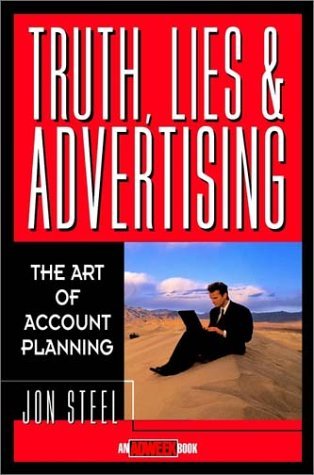
 マーケティングに関する書籍のレビュー シリーズの一環として、最近、ジョン スティールの「真実、嘘、広告: アカウント プランニングの芸術」をレビューしました。この本は広告に焦点を当てていますが、その内容はマーケティング サービスの他の分野にも応用できます。特に、広告キャンペーンにおける市場調査に関する視点をぜひ読みたいと思いました。
Steel の目標は、人間とその感情の複雑さに基づいた新しい広告モデルを提案することです。このモデルには、広告キャンペーンの関係者のパートナーシップが組み込まれています。
- クライアントのビジネス観点
- エージェンシーのクリエイティブな視点
- opinions and prejudices of the people at whom advertising is aimed; In other words, the consumer needs to be probed for insecurities, motivations, habits, and prejudices
これらの視点を「三角測量」することで、より真実に近づくことができます。このモデルの根底にあるのは、混沌に対する理解です。スティールの主張は、全体の合計は個々の部分よりも大きいということです。逆に、1 つの視点が支配的になると、広告キャンペーンの品質と効果が低下する可能性があります。スティールは、混沌はクライアントに最高の仕事を提供するのに役立つ可能性があると指摘しています。
- 広告研究に影響を与える環境
- 彼らはどんな気分になるのでしょうか?
- チャンス(奨励されるべき)
スティールはさらに、混沌に関して量子物理学と広告の間に意外な類似点を見出しています。最終的にスティールは、量子物理学における混沌と相反する視点への欲求は、多様な視点へのアプローチに似ていると示唆しています。
Steel continues to define Advertising according to Jeff Goodby’s definition: getting into one’s mind and changing one’s mind, but not telling one how to think. Along these lines, Steel asserts that Advertising cannot sell something; instead it influences the mind, which can influence purchasing.
So is advertising art or business? Goodby stated that Advertising was the Business of Changing Minds. Hence, it appears that Advertising is a mix of art and commerce, leaning toward commerce. Conceiving Advertising mostly as an art is problematic as it raises the problem of putting the interests of the creative above those of the client’s. Steel implies that Advertisers need to realize that the objective of their clients is to sell products or ideas.
さらに、広告は科学か芸術か?スティール氏は、広告は人間の感情の複雑さを無視しているため科学ではないと述べています。科学は、マーガレット・ウィートリーの機械モデルに従って構成要素を分解し、再構築できることを前提としています。スティール氏によると、過度に科学的なデータは、木に焦点を当てて森を無視する可能性があります。
Steel writes about the power of the unscientific method. He cites evidence that some of the best brains, including Einstein, Oppenheimer (a physicist), and Watson/Crick, deviated from the scientific method by combining science and art (intuition, fantasy). Steel implies that this occurred because these great thinkers realized that the scientific method could not explain everything.
Contextually, advertising faces several problems in reaching consumers. Advertising is directed at people, and tries to tell them what to do. Messages have been overused. Consequently, people dislike advertising. Steel proposes that the Holy Trinity in Advertising consists of:
- シンプルさ
- 常識
- 創造性
研究に関するアイデア
Steel asserts that clients assume that those on the outside share their same amount of knowledge, and that it was the role of the planner needs to change this. He indicates that the focus group moderator should have the power to introduce a completely new idea and deviate from the discussion guide. For example, he worked on a project on “Disability Insurance,” which by itself is a word that makes people shudder. Exploratory research was employed to allow the respondent to freely think and speak her thoughts. He found that respondents considered disability insurance as a necessary evil. As a result, the resulting ad campaign focused on the wide picture of the future and the realities that would impact some of the population. The message was that the company had your interests at heart.
Steel also claims that researchers need to look at what is not being said. Citing the example of a project for KPMG Peat Marwick, he had conducted many interviews with high-level executives. All research interviews consisted of the respondent telling the interviewer that what they were saying was all confidential. Hence, he came up with the idea to make a slogan conveying the exciting, stealthy, and confidential nature of what KPMG did.
Ultimately, the book has invigorating examples of creative advertisements. Its easy-to-read writing style is consistent with his overall theories on simplicity and common sense in advertising. Its theories on advertising campaign are helpful in conceptualizing the most effective advertising campaign. Our only displeasure was that its ideas on research did not add much in value from other authors in the genre, such as Clotaire Rapaille author of the “Culture Code.


 JA
JA  EN
EN  AR
AR  ZH
ZH  ZH_HK
ZH_HK  NL
NL  FR
FR  DE
DE  IT
IT  KO
KO  PL
PL  PT
PT  ES
ES