
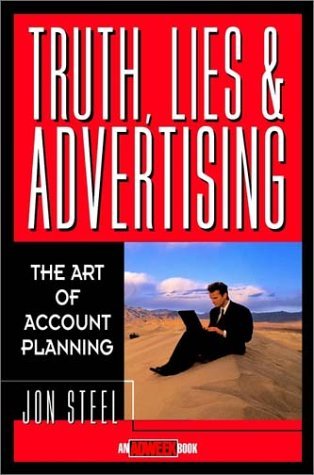
 Como parte de nossa série de resenhas de livros de marketing, revisamos recentemente “Truth, Lies and Advertising: the Art of Account Planning”, de Jon Steel. Embora focado na publicidade, o conteúdo do livro pode ser aplicado a outros ramos de serviços de marketing. Em particular, estávamos ansiosos para ler a sua perspectiva sobre pesquisas de mercado em campanhas publicitárias.
O objetivo da Steel é propor um novo modelo de publicidade baseado na complexidade das pessoas e nas suas emoções. O modelo incorpora uma parceria de stakeholders em uma campanha publicitária:
- perspectiva de negócios do cliente
- perspectiva criativa da agência
- opinions and prejudices of the people at whom advertising is aimed; In other words, the consumer needs to be probed for insecurities, motivations, habits, and prejudices
Ao “triangular” essas perspectivas, podemos chegar mais perto da verdade. Subjacente a este modelo está a sua apreciação pelo caos. A justificativa de Steel é que a soma do todo é maior que as partes individuais. Por outro lado, se for permitido que uma perspectiva domine, a qualidade e a eficácia de uma campanha publicitária podem ser prejudicadas. O caos, indica Steel, pode ser útil para fornecer o melhor trabalho aos clientes.
- Ambiente afetando pesquisas sobre publicidade
- Que tipo de humor isso os deixa?
- Chance (deve ser incentivada)
Steel continua traçando um paralelo inesperado entre a Física Quântica e a Publicidade, em referência ao caos. Em última análise, Steel implica que o caos e o desejo por perspectivas conflitantes na Física Quântica são semelhantes à sua abordagem de diversas perspectivas.
Steel continues to define Advertising according to Jeff Goodby’s definition: getting into one’s mind and changing one’s mind, but not telling one how to think. Along these lines, Steel asserts that Advertising cannot sell something; instead it influences the mind, which can influence purchasing.
Então a publicidade é arte ou negócio? Goodby afirmou que a publicidade era o negócio de mudar mentes. Assim, parece que a Publicidade é uma mistura de arte e comércio, inclinando-se para o comércio. Conceber a Publicidade principalmente como uma arte é problemático, pois levanta o problema de colocar os interesses do criativo acima dos interesses do cliente. Steel implica que os anunciantes precisam perceber que o objetivo de seus clientes é vender produtos ou ideias.
Além disso, a publicidade é uma ciência ou uma arte? Steel afirma que a publicidade não é uma ciência porque negligencia a complexidade das emoções humanas. A ciência pressupõe que você pode decompor os componentes e reconstruir as coisas de acordo com o modelo de máquina de Margaret Wheatley. Dados excessivamente científicos podem, segundo Steel, focar nas árvores e negligenciar a floresta.
Steel writes about the power of the unscientific method. He cites evidence that some of the best brains, including Einstein, Oppenheimer (a physicist), and Watson/Crick, deviated from the scientific method by combining science and art (intuition, fantasy). Steel implies that this occurred because these great thinkers realized that the scientific method could not explain everything.
Contextualmente, a publicidade enfrenta vários problemas para chegar aos consumidores. A publicidade é dirigida às pessoas e tenta dizer-lhes o que fazer. As mensagens foram usadas em demasia. Conseqüentemente, as pessoas não gostam de publicidade. Steel propõe que a Santíssima Trindade na Publicidade seja composta por:
- simplicidade
- senso comum
- criatividade
Ideias sobre pesquisa
Steel asserts that clients assume that those on the outside share their same amount of knowledge, and that it was the role of the planner needs to change this. He indicates that the focus group moderator should have the power to introduce a completely new idea and deviate from the discussion guide. For example, he worked on a project on “Disability Insurance,” which by itself is a word that makes people shudder. Exploratory research was employed to allow the respondent to freely think and speak her thoughts. He found that respondents considered disability insurance as a necessary evil. As a result, the resulting ad campaign focused on the wide picture of the future and the realities that would impact some of the population. The message was that the company had your interests at heart.
Steel also claims that researchers need to look at what is not being said. Citing the example of a project for KPMG Peat Marwick, he had conducted many interviews with high-level executives. All research interviews consisted of the respondent telling the interviewer that what they were saying was all confidential. Hence, he came up with the idea to make a slogan conveying the exciting, stealthy, and confidential nature of what KPMG did.
Em última análise, o livro traz exemplos revigorantes de anúncios criativos. Seu estilo de escrita fácil de ler é consistente com suas teorias gerais sobre simplicidade e bom senso em publicidade. Suas teorias sobre campanha publicitária são úteis na conceituação da campanha publicitária mais eficaz. Nosso único desagrado foi que suas ideias sobre pesquisa não agregaram muito valor a outros autores do gênero, como Clotaire Rapaille, autor do “Código da Cultura”.


 PT
PT  EN
EN  AR
AR  ZH
ZH  ZH_HK
ZH_HK  NL
NL  FR
FR  DE
DE  IT
IT  JA
JA  KO
KO  PL
PL  ES
ES