
Palm Oil Markt Forschung
Was ist Palmöl?
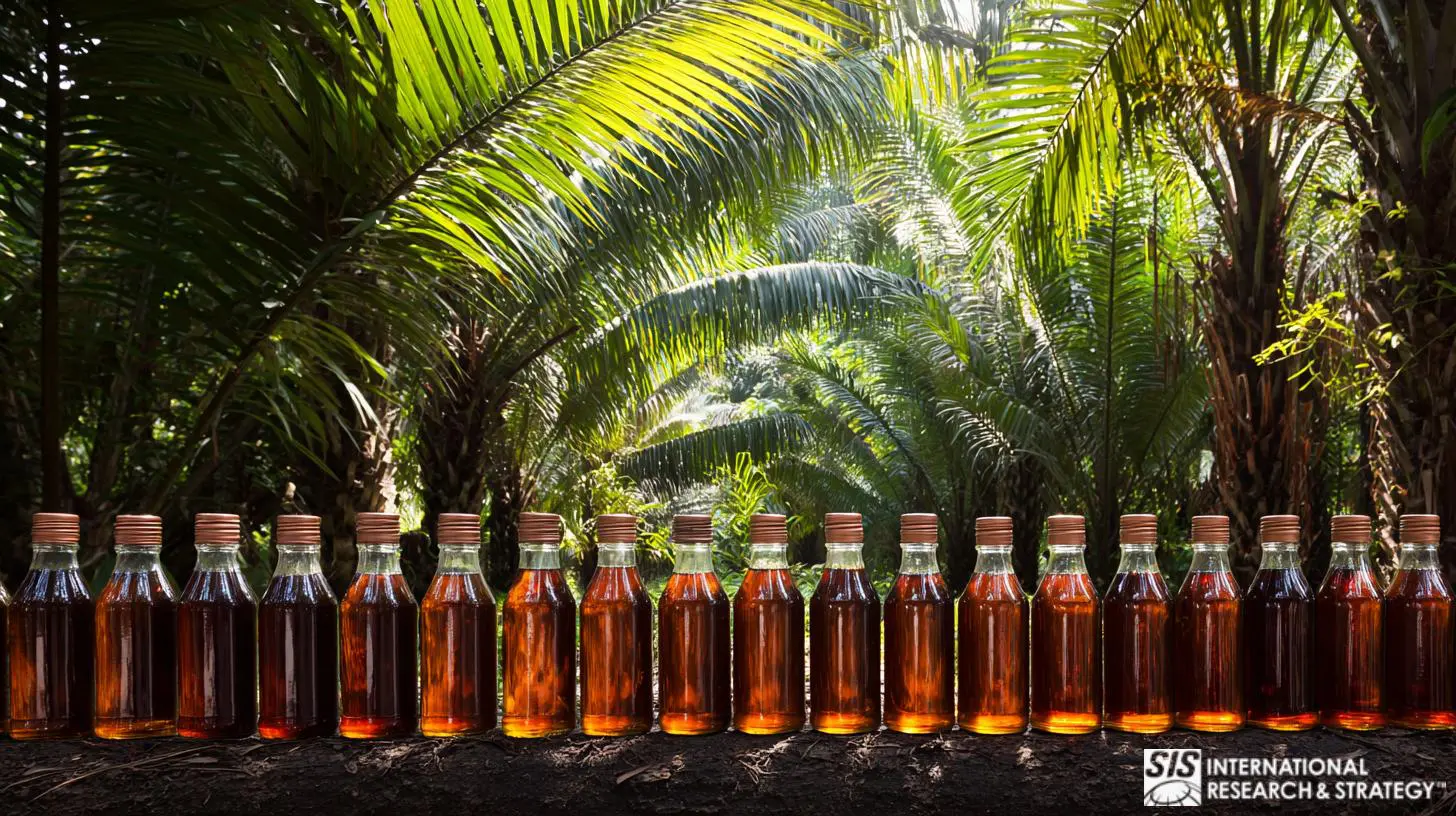
Palmöl ist eines der weltweit am meisten produzierten Öle. Es wird aus dem Fruchtfleisch von Palmen gewonnen, die in Westafrika heimisch sind. Mittlerweile wird es jedoch auch in Asien und Lateinamerika angebaut. Es ist allgemein als hochwertiges Speiseöl bekannt, das in den meisten Entwicklungsländern weit verbreitet ist. In vielen Produkten wird Palmöl verwendet, darunter in Lebensmitteln und Non-Food-Artikeln, Industrieanlagen, Kosmetika und Biokraftstoffen.
Palm Oil Market Research: How Leading Buyers Build Sourcing Advantage
Palm oil sits at the center of consumer goods, biofuels, and oleochemicals. Few commodities carry comparable strategic weight or regulatory exposure.
For Fortune 500 procurement, brand, and sustainability leaders, palm oil market research has shifted from a price-tracking exercise to a multi-variable intelligence function. The buyers gaining ground treat the supply chain as a system of interdependent risks: yield cycles in Sumatra and Sarawak, EUDR traceability mandates, RSPO certification economics, biodiesel blending policy in Jakarta, and shifting refining margins in Rotterdam and Mumbai. The leaders source intelligence accordingly.
Why Palm Oil Market Research Now Drives Margin, Not Just Compliance
Crude palm oil (CPO) and palm kernel oil (PKO) move on different fundamentals than most agricultural commodities. Yield is biological and lagging: a tree planted today produces commercial fruit in three years and peaks near year eight. That biological clock makes replanting cycles in Indonesia and Malaysia the single most important medium-term supply variable, and it is one that price screens do not capture.
The buyers who outperform read the replanting curve, the El Niño signal in MPOB stock data, and the Indonesian B40 biodiesel mandate as one connected picture. When Pertamina absorbs more domestic CPO for blending, export availability tightens regardless of headline production. Procurement teams that model this linkage hedge earlier and lock tonnage at better basis.
According to SIS International Research, multinational buyers conducting structured B2B expert interviews with refiners, plantation operators, and certification auditors consistently identify three sources of margin advantage: earlier visibility into smallholder yield variance, direct relationships with mid-tier mills outside the top integrated players, and granular reading of port-level inventory at Dumai, Belawan, and Lahad Datu.
The Sustainability Premium Is Becoming a Pricing Mechanism
RSPO segregated and identity-preserved palm oil have traded at premiums over mass balance and conventional CPO for years. The EU Deforestation Regulation has changed what those premiums mean. Traceability to the plot, not the mill, is now the operative standard for goods entering the European market. Geolocation data, polygon mapping, and chain-of-custody audits have moved from sustainability reporting into procurement contracts.
Unilever, Nestlé, and Ferrero have published supplier mill lists and tightened NDPE (No Deforestation, No Peat, No Exploitation) clauses. The competitive read is that traceability is converging into a baseline. The differentiation now sits in cost-to-comply: which buyers built supplier qualification audits and grievance systems early, and which are paying spot premiums to catch up.
Smallholders produce roughly 40 percent of global supply and remain the hardest segment to verify. Buyers investing in jurisdictional sourcing programs in Sabah, Central Kalimantan, and Aceh are securing volume that EUDR-compliant refiners increasingly cannot find at scale.
Where the Real Intelligence Gaps Sit
Most published palm oil reports cover the same surface: production by country, export flows, price history, and certification volumes. The decisions a VP of Procurement or VP of Sustainability actually faces require deeper inputs.
- Mill-level competitive intelligence. Which mills supply which refiners, on what contract length, and with what NDPE compliance history.
- Refining margin decomposition. The spread between CPO, RBD palm olein, and stearin moves with biodiesel demand, oleochemical pull, and Chinese soybean oil substitution.
- Policy scenario modeling. Indonesian export levy structure, Malaysian windfall tax thresholds, and Indian import duty differentials between CPO and refined palm olein reshape landed cost faster than any market fundamental.
- Substitution economics. When does soybean, rapeseed, sunflower, or shea reformulation become viable, and at what functional cost in confectionery, surfactants, or frying applications.
SIS International’s competitive intelligence engagements across edible oils and oleochemicals indicate that buyers who commission mill-tier supplier mapping, paired with expert interviews among trading desks in Singapore and Kuala Lumpur, consistently identify volume and pricing dislocations months before they appear in MPOB or GAPKI bulletins.
The Demand Side Is Diversifying Faster Than Supply
Food applications still account for the majority of global palm oil consumption, but the growth vectors are industrial. Oleochemicals (fatty acids, fatty alcohols, glycerine) feed personal care, detergents, and lubricants. HVO and SAF (hydrotreated vegetable oil and sustainable aviation fuel) producers in Singapore, Rotterdam, and the U.S. Gulf are bidding for waste streams (POME, PFAD) and increasingly for virgin feedstock.
This is the underappreciated structural shift. PFAD (palm fatty acid distillate) was a low-value byproduct a decade ago. Renewable diesel demand has repriced it. Food and feed buyers who treated PFAD as a cheap input are now competing with Neste, Marathon, and Phillips 66 for the same molecules. Total cost of ownership in formulation has moved.
A Practical Framework for Palm Oil Market Research
The buyers extracting the most value from palm oil market research organize intelligence into four layers. Each layer has a different decision owner and a different refresh cycle.
| Layer | Decision Owner | Core Inputs | Refresh Cycle |
|---|---|---|---|
| Macro supply-demand | Category director | MPOB, GAPKI, USDA, weather, biodiesel mandates | Monthly |
| Origin and policy | Procurement VP | Export levies, import duties, EUDR enforcement posture | Quarterly |
| Mill and refiner mapping | Sourcing manager | NDPE compliance, capacity, ownership, grievance log | Semi-annual |
| Substitution and reformulation | R&D and sustainability | Functional benchmarking, cost parity, consumer acceptance | Annual |
Source: SIS International Research
The framework matters because most procurement organizations collapse these layers into a single quarterly review. The cycles are different, the data sources are different, and the decisions are different. Separating them is the operational unlock.
What Leading Buyers Do Differently
Three patterns separate the top quartile of palm oil buyers from the rest.
First, they invest in primary research at origin. Plantation visits, mill audits, and structured interviews with traders in Singapore, Mumbai, and Rotterdam produce signal that no subscription database delivers. SIS International’s market entry assessments and supplier qualification audits in Indonesia and Malaysia have repeatedly surfaced contract terms, NDPE breaches, and capacity constraints that public reporting captured only after the next quarter’s price move.
Second, they treat sustainability and procurement as one function. Splitting RSPO certification work from tonnage negotiation leaves money on the table. The mills willing to invest in segregation and traceability are the same mills that reward long-term offtake commitments.
Third, they build substitution optionality before they need it. Reformulation cycles in food and personal care take twelve to thirty-six months. Buyers who run continuous functional benchmarking against shea, sal, mango kernel, and high-oleic oils have a credible exit, and that credibility shapes contract terms with palm suppliers.
Where Palm Oil Market Research Heads Next
Three forces will shape the next phase of palm oil market research. EUDR enforcement will harden, pulling traceability investment forward across all major buyers. Indonesian biodiesel ambition will continue to compete with food and oleochemical demand for the same molecules. And Latin American supply, particularly Colombia and Guatemala, will gain share as buyers diversify origin risk.
The intelligence function that wins is the one tied directly to procurement, sustainability, and R&D decisions in the same quarter they are made. Palm oil market research delivers the most value when it is commissioned to answer a specific contract, formulation, or policy question, not to populate a dashboard.
Key Questions

Q: What does palm oil market research cover for a Fortune 500 buyer?
A: It covers macro supply-demand, origin policy, mill and refiner competitive mapping, sustainability compliance economics, and substitution analysis, organized to support specific procurement, reformulation, and sustainability decisions.
Q: How is palm oil market research different from general commodity research?
A: Palm oil intelligence requires plot-level traceability, NDPE compliance auditing, biodiesel mandate modeling, and mill-tier supplier mapping. Standard commodity research stops at country-level production and price.
Q: How does the EU Deforestation Regulation change palm oil sourcing?
A: EUDR requires geolocation traceability to the plot of origin, shifting compliance cost into procurement contracts and rewarding buyers who built jurisdictional sourcing programs and supplier qualification audits early.
Q: Why does Indonesian biodiesel policy matter for global palm buyers?
A: When Indonesia raises its biodiesel blending mandate, domestic CPO absorption rises and export availability tightens, moving global prices and basis regardless of total production volume.
Q: What are the most overlooked variables in palm oil sourcing?
A: Replanting cycles, smallholder yield variance, PFAD repricing from renewable diesel demand, and refining margin decomposition between olein and stearin.
Über SIS International
SIS International bietet quantitative, qualitative und strategische Forschung an. Wir liefern Daten, Tools, Strategien, Berichte und Erkenntnisse zur Entscheidungsfindung. Wir führen auch Interviews, Umfragen, Fokusgruppen und andere Methoden und Ansätze der Marktforschung durch. Kontakt für Ihr nächstes Marktforschungsprojekt.

 DE
DE  EN
EN  AR
AR  ZH
ZH  ZH_HK
ZH_HK  NL
NL  FR
FR  IT
IT  JA
JA  KO
KO  PL
PL  PT
PT  ES
ES