
Ricerche di mercato in Java

Condurre ricerche di mercato a Giava è una mossa intelligente per le aziende che vogliono sfruttare il cuore economico dell'Indonesia.
Java è più di un semplice fulcro dell'economia indonesiana; è un mercato diversificato e complesso che richiede un approccio sfumato. La ricerca di mercato a Java fornisce gli strumenti di cui le aziende hanno bisogno per orientarsi tra le industrie in crescita e l'ambiente competitivo dell'isola.
TIndice
Che cosa sono le ricerche di mercato in Java?
Le ricerche di mercato in Java aiutano le aziende a comprendere meglio il comportamento dei consumatori, le tendenze del settore e le normative locali, fornendo loro i dati di cui hanno bisogno per avere successo in questo mercato competitivo.
Il mercato di Java è diversificato e comprende tutto, dall'agricoltura e la produzione ai servizi digitali e alla vendita al dettaglio. Le aziende affrontano sfide uniche in ogni settore, tra cui la navigazione dei requisiti normativi, la comprensione delle preferenze dei consumatori regionali e la competizione in mercati altamente saturi. Conducendo ricerche di mercato in Java, le aziende possono prendere decisioni informate su dove concentrare i propri sforzi, come posizionare i propri prodotti e come interagire efficacemente con il proprio pubblico di riferimento.
Perché Java è importante?

Java fornisce la maggior parte del chinino mondiale. L'isola è anche un produttore di petrolio con tre raffinerie. La principale coltura alimentare è il riso umido e oltre due terzi della terra sono coltivati. La capacità di coltivazione del riso dell'isola è cresciuta nel corso dei secoli. Questa crescita è dovuta alla complessa rete predisposta per fornire acqua alle colture.
Commercio e industria sono i principali motori della crescita dell'isola. Giava è, di gran lunga, la parte più sviluppata del paese, con l'economia più varia. Ha una solida base di consumatori e un settore dei servizi sviluppato.
La nostra attuale revisione del mercato e raccomandazioni
Per comprendere le sfide e le opportunità uniche in queste aree è necessario un approccio basato sui dati per il processo decisionale. Raccomandiamo alle aziende di concentrarsi sui centri urbani di Giava, in particolare Giacarta, Surabaya e Bandung, dove la crescente classe media sta guidando la domanda di beni di consumo, tecnologia e servizi.
Le ricerche di mercato a Giava possono fornire preziose informazioni sul comportamento dei consumatori in queste città, aiutando le aziende a personalizzare le loro offerte per soddisfare le preferenze locali. Inoltre, il settore agricolo di Giava rimane un fattore chiave per l'economia e le aziende coinvolte nell'agroalimentare o nella lavorazione alimentare possono trarre vantaggio dalla comprensione delle dinamiche della catena di fornitura e della domanda di mercato.
Key Dynamics of the Java, Indonesia Market
| Key Market Aspect | Characteristic & Significance | Market Research Focus & Implication |
|---|---|---|
| National Economic Core | As the political and financial hub (including Jakarta), Java drives the majority of Indonesia’s **GDP** and contains major manufacturing centers. | **B2B market studies** and **regulatory trend analysis** are critical for finance, infrastructure, and heavy industry sectors. |
| Massive Consumer Base | Extremely **high population density** (over 150 million people), with a young, rapidly urbanizing, and increasingly middle-class demographic. | Deep **consumer segmentation** (e.g., urban, suburban, generational) is necessary for successful **FMCG** and service launches. |
| Dominio digitale | High **mobile penetration** fuels explosive growth in e-commerce, FinTech, ride-hailing, and digital banking services. | Focus on **mobile-first strategies**, analyzing user experience (**UX**), digital payment adoption, and competitor analysis in the tech sector. |
| Sfide logistiche | While connectivity is improving, major cities face acute **traffic congestion** and **supply chain bottlenecks** that impact delivery speed and cost. | Need for **supply chain optimization** studies, logistics partner evaluations, and detailed analysis of distribution channel effectiveness. |
Città, regioni e quartieri
Giacarta è la capitale e la città più grande dell'Indonesia. Si trova nell'angolo nord-occidentale di Giava. Questa città gigantesca e tentacolare sta crescendo rapidamente.
Surabaya si trova nella provincia di Giava Orientale. Questa città è stata il principale centro commerciale di Giava orientale sin dal XIV secolo.
Bandung si trova nella provincia di Giava Occidentale. Si trova all'interno di Giava, all'estremità settentrionale di un altopiano a quasi 2400 piedi sopra il livello del mare. Fondata nel 1810 dagli olandesi, la città ha un clima mite e piacevole.
Industrie chiave

Nonostante le grandi dimensioni dell'Indonesia, la maggior parte della produzione del paese si trova a Giava. Le industrie primarie sono tessili e di abbigliamento. Anche le industrie del legno, della lavorazione alimentare e non metalliche sono notevoli sull'isola. La provincia di Giava Occidentale ha un terreno fertile. Rappresenta un quinto della produzione di riso del paese e due terzi del suo tè. Giava Orientale è la sede dell'industria cantieristica del paese. È anche la sede della più grande fabbrica di cemento.
Opportunità nella ricerca di mercato in Java
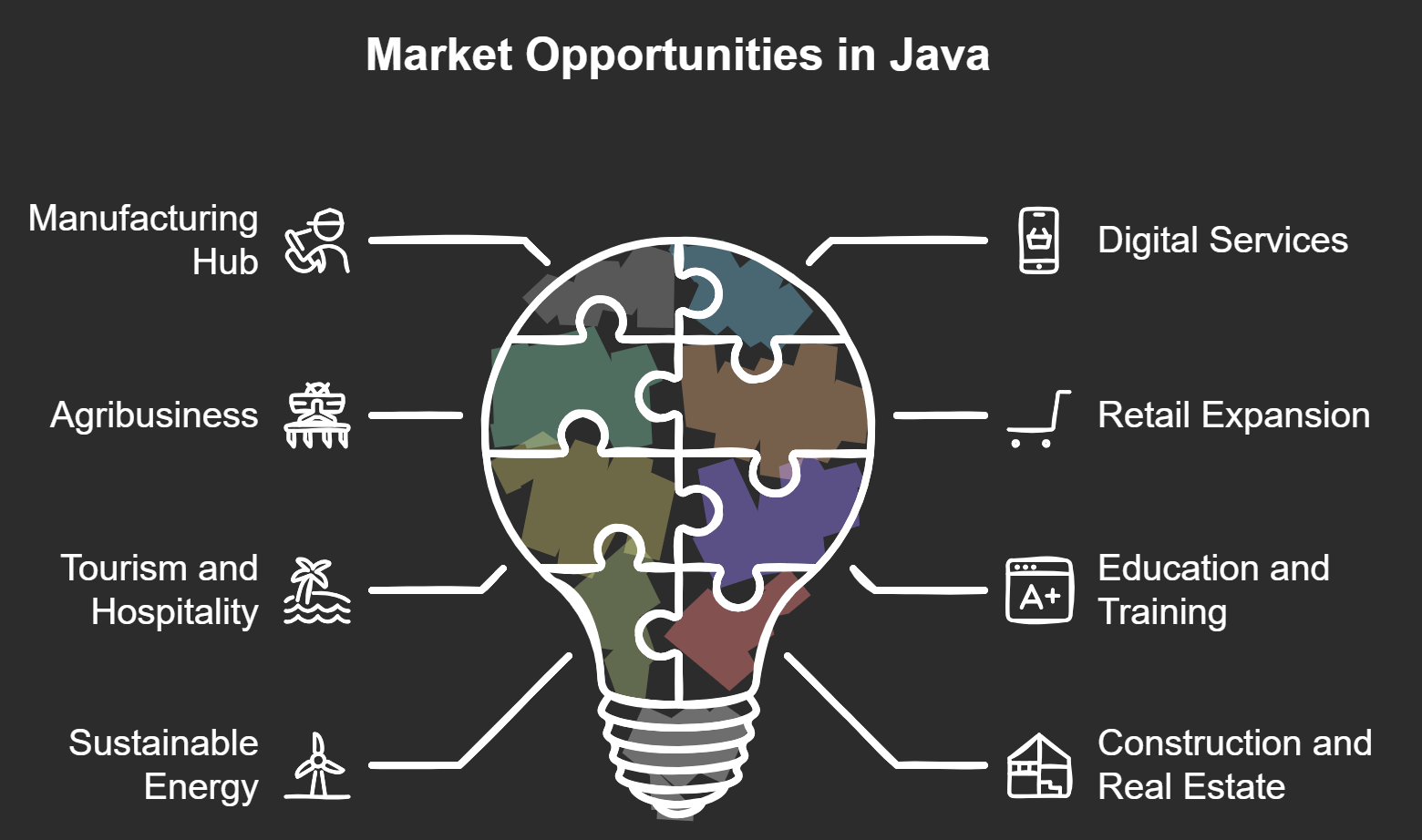
Java offre numerose opportunità in un'ampia gamma di settori, rendendolo una destinazione privilegiata per l'espansione aziendale. La ricerca di mercato in Java è essenziale per identificare queste opportunità e sviluppare strategie per capitalizzarle.
- Centro di produzione: Giava è il centro industriale dell'Indonesia e offre opportunità alle aziende attive nel settore manifatturiero, dall'automotive all'elettronica.
- Servizi digitali: Grazie alla crescente popolarità della popolazione in ambito tecnologico, aumenta la domanda di e-commerce, fintech e altri servizi digitali, soprattutto nelle aree urbane.
- Agroalimentare: Giava continua a essere un importante produttore agricolo, offrendo opportunità alle aziende agroalimentari nell'agricoltura sostenibile, nella trasformazione alimentare e nelle esportazioni.
- Espansione al dettaglio:La rapida urbanizzazione della classe media sta stimolando la domanda di beni di consumo, creando opportunità nei settori della vendita al dettaglio, della moda e dell'elettronica.
- Turismo e Ospitalità:Il ricco patrimonio culturale e le attrazioni naturali di Giava ne fanno un centro turistico in crescita, con opportunità di hotel, servizi di viaggio e intrattenimento.
- Istruzione e formazione:Con una popolazione giovane desiderosa di migliorare le proprie competenze, le aziende che offrono programmi di formazione professionale e istruzione superiore hanno un potenziale significativo.
- Energia sostenibile:Il governo indonesiano sta investendo nelle energie rinnovabili, in particolare nell'energia solare ed eolica, aprendo nuove opportunità nel campo delle tecnologie verdi.
- Edilizia e Immobiliare:L'urbanizzazione sta determinando una domanda di nuove infrastrutture, alloggi e sviluppi commerciali, in particolare nelle grandi città.
- Servizi di assistenza sanitaria:La domanda di servizi e prodotti sanitari è in aumento, creando spazio per le aziende nei settori dei servizi medici, farmaceutici e delle soluzioni tecnologiche per la salute.
- Soluzioni per la logistica e la catena di fornitura: Giava funge da porta d'accesso al commercio nazionale e internazionale, pertanto i servizi di logistica e trasporto sono molto richiesti.
Come la ricerca di mercato di SIS International in Java aiuta le aziende

La ricerca di mercato di SIS International su Java offre alle aziende le informazioni e i dati di cui hanno bisogno per avere successo nel più grande polo economico dell'Indonesia. La nostra ricerca di mercato consente alle aziende di prendere decisioni informate che si allineano con il panorama economico diversificato e le opportunità di crescita di Java.
Pianificazione strategica migliorata: SIS Internazionale fornisce alle aziende una conoscenza approfondita del panorama economico e culturale di Giava, consentendo loro di sviluppare strategie efficaci che incontrano il gradimento dei consumatori locali e soddisfano le esigenze specifiche del settore.
Aumento delle entrate:Identificando settori ad alta crescita come servizi digitali, vendita al dettaglio e produzione, SIS International aiuta le aziende a posizionare la propria offerta per massimizzare i ricavi e la quota di mercato in Java.
Riduzione del rischio: Nostro ricerca di mercato identifica i potenziali rischi correlati alle sfide normative, ai vincoli infrastrutturali e alle normative ambientali, aiutando le aziende a mitigare tali rischi e a operare senza problemi in Java.
Miglioramento dell'efficienza del marketingGrazie a informazioni dettagliate sul comportamento dei consumatori e sulle differenze dei mercati regionali, SIS International aiuta le aziende a perfezionare le proprie strategie di marketing per raggiungere in modo efficace il pubblico giusto e ottenere maggiori ritorni sugli investimenti.
Crescita accelerata e innovazione:Scoprire le tendenze emergenti in settori come l'e-commerce, le energie rinnovabili e l'assistenza sanitaria, SIS supporta le aziende nel favorire la crescita e l'innovazione nell'economia in rapida evoluzione di Giava.
ROI potenziato: Grazie a un processo decisionale basato sui dati e a informazioni fruibili, le aziende possono ottimizzare i propri investimenti, assicurando un elevato ritorno sull'investimento e realizzando al contempo una crescita sostenibile nel dinamico mercato di Java.
La nostra sede a New York
11 E 22nd Street, Piano 2, New York, NY 10010 T: +1(212) 505-6805
A proposito di SIS Internazionale
SIS Internazionale offre ricerca quantitativa, qualitativa e strategica. Forniamo dati, strumenti, strategie, report e approfondimenti per il processo decisionale. Conduciamo anche interviste, sondaggi, focus group e altri metodi e approcci di ricerca di mercato. Contattaci per il tuo prossimo progetto di ricerca di mercato.

 IT
IT  EN
EN  AR
AR  ZH
ZH  ZH_HK
ZH_HK  NL
NL  FR
FR  DE
DE  JA
JA  KO
KO  PL
PL  PT
PT  ES
ES