
Ricerche di mercato sui prodotti per pannolini per bambini

Mentre i genitori a livello globale cercano il meglio per i loro piccoli… In che modo le aziende garantiscono che le loro offerte soddisfino e superino gli standard in continua evoluzione di sicurezza, comfort e sostenibilità ambientale? La ricerca di mercato sui pannolini per bambini emerge come lo strumento fondamentale in questa ricerca, offrendo preziose informazioni sulle preferenze dei consumatori, sulle tendenze del mercato e sui panorami competitivi.
La ricerca di mercato sui prodotti per pannolini per bambini è un processo sistematico che raccoglie, analizza e interpreta le informazioni sul mercato dei pannolini per bambini, comprese le preferenze dei consumatori, le dimensioni del mercato, le tendenze di crescita, il panorama competitivo e le innovazioni emergenti. Questa ricerca funge da pietra angolare per le aziende del settore dei pannolini, guidando lo sviluppo del prodotto, le strategie di marketing e gli approcci di vendita.
Baby diaper product market research allows businesses to tap into parents evolving preferences, ensuring their offerings resonate with modern consumers’ values and demands. Additionally, comprehensive market research provides insights into competitors’ strategies, strengths, and weaknesses, enabling businesses to identify unique positioning opportunities and differentiate their products effectively.
Market research helps companies identify emerging trends and gaps in the market, guiding the development of innovative products that meet untapped consumer needs or improve upon existing solutions. Moreover, baby diaper product market research provides the data and insights to make informed decisions, reducing the likelihood of costly missteps and focusing resources on the most promising opportunities.
Table of Contents
Baby Diaper Product Market Research: How Category Leaders Win Share
The diaper category rewards brands that read the household, not just the shelf. Premiumization, fit innovation, and channel fragmentation have shifted where margin is made.
Baby Diaper Product Market Research has moved from descriptive volume tracking to behavioral evidence that directly shapes SKU architecture, claims hierarchy, and pricing tiers. The brands gaining share are the ones converting in-home observation into product specification and shopper messaging.
Why Baby Diaper Product Market Research Now Drives Category Strategy
Diaper economics are defined by three pressures: pulp and SAP (superabsorbent polymer) input volatility, private label encroachment in mass channels, and the rise of pants-format products that cannibalize tape diapers earlier in the size curve. Each compresses margin if the brand cannot defend a functional or emotional claim.
Category leaders separate on three vectors: absorption performance per gram, skin-contact materials, and fit at the leg cuff and waistband. These are the attributes parents notice within the first three uses, and they predict repeat purchase more reliably than brand affinity. Concept-product fit testing, not concept testing alone, is what isolates which design changes a household will actually pay for.
Kimberly-Clark, Procter and Gamble, Unicharm, Kao, Essity, and Ontex compete on different formulations of the same trade-off: thinner core versus leakage protection. Regional players such as Hengan and Daio Paper have built share by optimizing for local body shape data and local price ladders rather than importing global platforms.
What Ethnographic Evidence Reveals That Retail Data Cannot
Scanner data shows what was bought. It does not show why a mother switched mid-size, why a grandmother overrides the brand choice, or why a household keeps two brands in rotation. These mechanics decide share.
SIS International’s ethnographic research across diaper-using households in China, India, the United States, and Brazil found that purchase decisions are routinely made by a non-purchaser influencer in the home. In multigenerational Chinese households, grandparents drive change frequency and brand veto power, while in Indian households fathers and mothers diverge sharply on safety versus developmental concerns. Brands that segment only by the buyer miss the actual decision unit.
This is why in-home ethnographies and diary studies outperform claims-based concept tests in this category. Parents underreport leak incidents and overreport change frequency in surveys. Observed behavior closes the gap. SIS International has run global baby ethnographies pairing video diaries with structured caregiver interviews to map the full change ritual: pre-change cues, wipe selection, disposal behavior, and rash response.
In structured interviews conducted by SIS with caregivers across tier-one and tier-three Chinese cities, the dominant unmet need shifted from absorption to breathability and skin gentleness as disposable penetration matured. The same study found that potty training timing varies by more than twelve months across income tiers, which has direct implications for size-six and pants-format SKU sizing decisions.
How Pricing Architecture and Claims Hierarchy Decide Share
Diaper pricing is rarely won at the headline price. It is won at the price-per-count and price-per-absorption-unit a parent computes after the second pack. Premium tiers such as Pampers Pure, Huggies Special Delivery, and Merries hold price because the claim ladder is defensible: hypoallergenic certification, organic cotton contact layer, fragrance-free formulation, dermatologically tested.
Mid-tier brands lose share when claims overlap with private label. Costco’s Kirkland Signature, Target’s Up and Up, and Amazon’s Mama Bear have closed the functional gap on absorption and fit, leaving mid-tier national brands with weak differentiation. The defense is sensory and material: softer topsheet, quieter unfolding, visible wetness indicator placement, waistband elasticity recovery.
Claims hierarchy testing through CATA (check-all-that-apply) methodology and JAR (just-about-right) scales identifies which attributes are price-elastic and which are table stakes. Brands that test the wrong attribute at the wrong tier overpay for features parents discount.
Where Channel and Format Shifts Open New Margin
The category is fragmenting across three channels with different economics. Subscription DTC (Honest Company, Hello Bello, Coterie) commands premium pricing and capture data on size transitions in real time. Cross-border ecommerce, particularly in China and Southeast Asia, has rewritten how Japanese and Korean brands enter without local distribution. Modern trade in India and Indonesia is converting first-time users from cloth to disposables at the size-three entry point.
Pants-format diapers now dominate in much of Asia and are growing in Western markets for size four and above. The format shift changes the bill of materials, the production line economics, and the shopper journey. Brands that treat pants as a line extension rather than a distinct product platform underinvest in the fit work that determines repeat purchase.
| Formato | Primary Geography | Share Trajectory | Margin Profile |
|---|---|---|---|
| Tape diapers (newborn to size 3) | Globale | Stable to declining | Mid, pressured by private label |
| Pants format (size 3 and above) | Asia, expanding in EU and US | Growing | Premium-defensible |
| Premium DTC subscription | US, UK, urban Asia | Growing | High, with retention risk |
| Eco and biodegradable tier | EU, US, urban LATAM | Growing from small base | Premium, input-cost sensitive |
Source: SIS International Research
The SIS Diaper Decision Unit Framework

Diaper purchase is a household decision, not a buyer decision. The SIS Diaper Decision Unit Framework maps four roles that shape share outcomes:
- Initiator: typically the mother, sets the brand consideration set during pregnancy or first weeks postpartum.
- Influencer: pediatrician, lactation consultant, mother-in-law, or peer network, validates or vetoes the consideration set.
- Operator: caregiver who performs the most changes, detects leak, fit, and skin issues first.
- Purchaser: executes the buy, often optimizes for price-per-count and pack availability.
Brands that win address all four roles with distinct evidence. Pediatrician sampling programs, hospital bag placement, in-home trial kits, and price-pack architecture each target a different role. Treating the category as a single-shopper decision leaves measurable share on the table.
What Leading Manufacturers Are Investing In
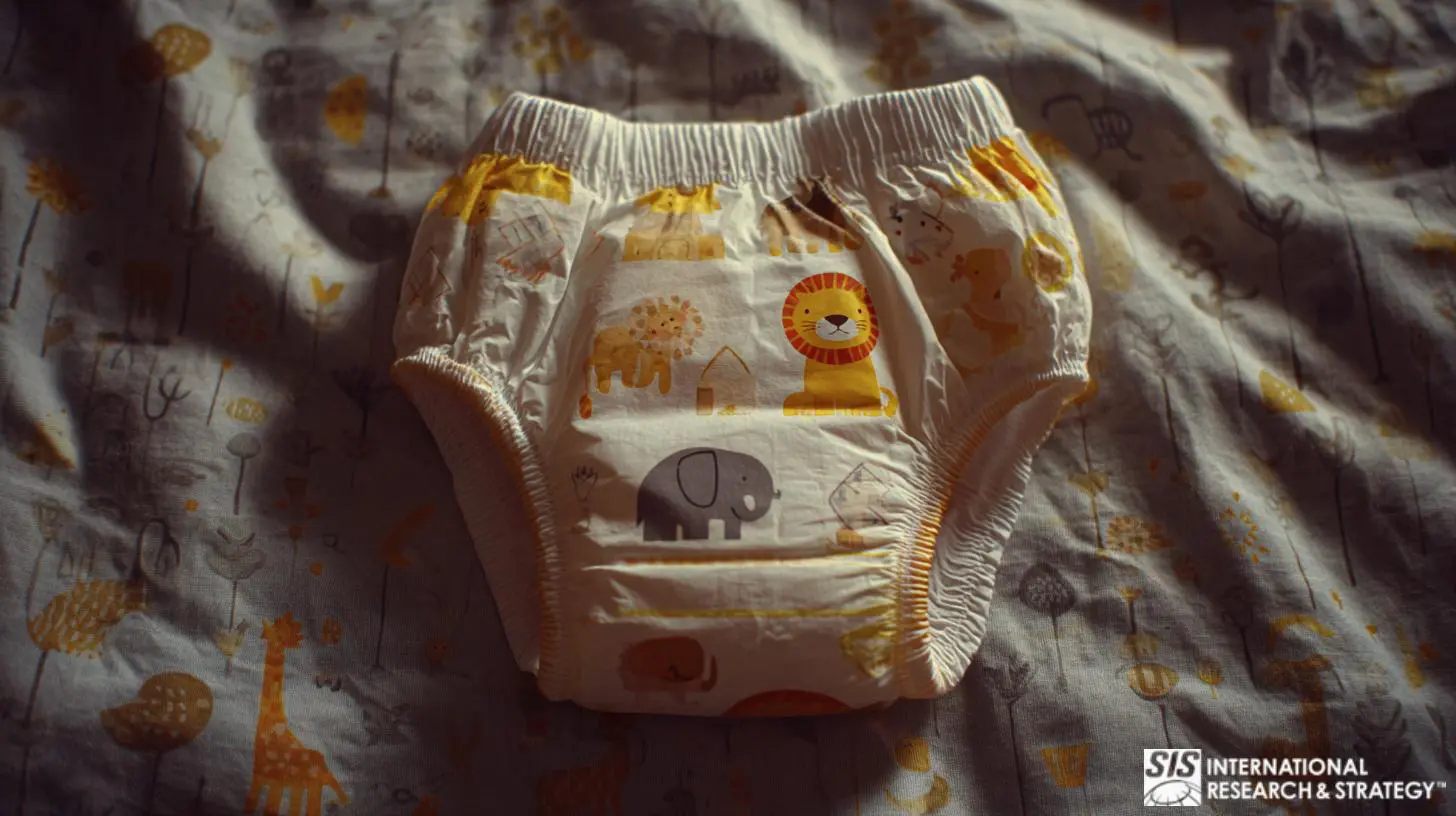
The next phase of differentiation is being built on three fronts. Sustainable materials, including bio-based SAP, FSC-certified pulp, and chlorine-free processing, are moving from marketing claim to specification standard in EU markets under extended producer responsibility regulations. Fit personalization, driven by anthropometric data on infant body shape variation across ethnicities, is reshaping size grading. Connected packaging and reorder triggers are turning the diaper bag into a retention asset for DTC brands.
Baby Diaper Product Market Research that combines CLT-based sensory benchmarking, in-home ethnography, expert interviews with pediatric dermatologists, and shopper journey analytics produces the evidence base these investments require. Single-method studies will not.
Where Baby Diaper Product Market Research Pays Back Fastest
Three decisions deliver the highest return on rigorous research: size-curve transition timing, premium-tier claims defensibility, and format-platform investment in pants versus tape. Each is a multi-year capital and inventory commitment. Each fails quietly when based on scanner data alone.
The brands compounding share are the ones treating Baby Diaper Product Market Research as continuous household intelligence, not episodic concept testing. The category rewards patience with evidence.
A proposito di SIS Internazionale
SIS Internazionale offre ricerca quantitativa, qualitativa e strategica. Forniamo dati, strumenti, strategie, report e approfondimenti per il processo decisionale. Conduciamo anche interviste, sondaggi, focus group e altri metodi e approcci di ricerca di mercato. Contattaci per il tuo prossimo progetto di ricerca di mercato.

 IT
IT  EN
EN  AR
AR  ZH
ZH  ZH_HK
ZH_HK  NL
NL  FR
FR  DE
DE  JA
JA  KO
KO  PL
PL  PT
PT  ES
ES