
Spiriti Ricerca di mercato
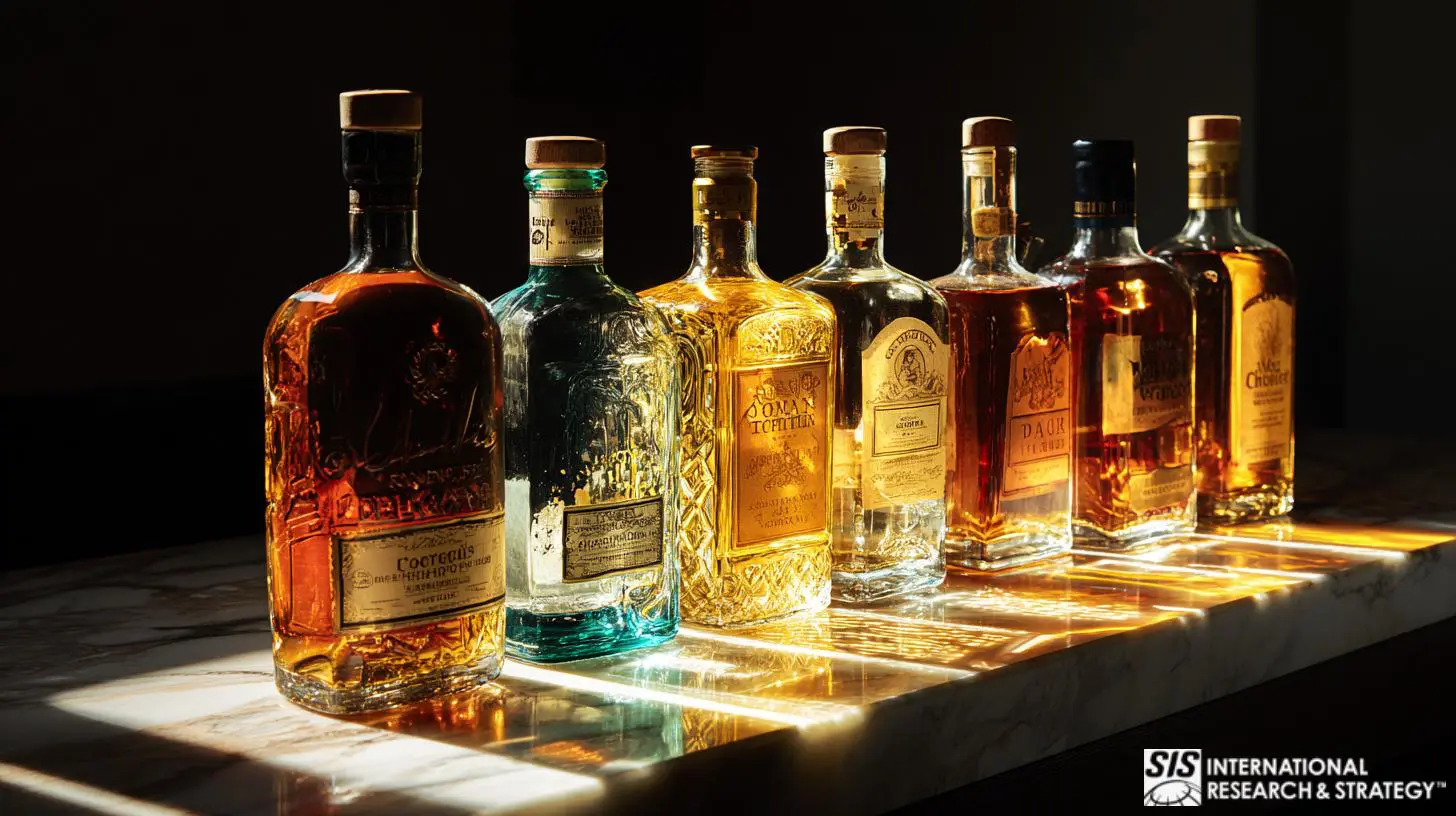
Il mercato degli alcolici è un settore dinamico e in rapida crescita dell’industria delle bevande e, con la crescente popolarità degli alcolici artigianali, premium e invecchiati, il mercato presenta opportunità e sfide per le aziende che desiderano avere successo in questo panorama competitivo. Ecco perché le ricerche di mercato sugli alcolici aiutano le aziende a orientarsi nelle complessità del settore, a identificare le principali tendenze del mercato e a sviluppare strategie di successo.
What Is Spirits Market Research?
Spirits market research provides businesses valuable insights into market trends, consumer preferences, competitor strategies, and regulatory issues affecting the industry. It covers various areas, including market size and growth projections, consumer demographics and behavior, distribution channels, pricing strategies, and brand perception.
Spirits Market Research: How Leading Brands Win the Premium Shelf
The spirits category rewards precision. Premium and super-premium tiers carry margin profiles two to three times the standard segment, and the gap between a winning launch and a stalled SKU often comes down to sensory calibration, occasion mapping, and on-trade visibility decisions made before the first bottle ships.
Spirits market research has matured from tracking depletions and household penetration into a discipline that connects sensory science, cultural context, and channel economics. Diageo, Pernod Ricard, Brown-Forman, Bacardi, and Suntory each operate proprietary insight teams. The brands gaining share against them, including Sazerac’s Buffalo Trace portfolio and Campari’s Aperol franchise, win by reading consumer signals earlier and translating them into liquid, pack, and price.
What Premium Spirits Market Research Now Measures
The category has split into distinct decision frames. Whisk(e)y, agave, rum, and clear spirits each follow different premiumization curves, and the research design has to follow the curve.
For agave, the question is provenance and additive transparency. For American whiskey, it is mash bill differentiation and finish. For rum, it is age-statement credibility against a category long discounted by flavored variants. For gin and vodka, it is occasion fit, given the structural shift toward lower-ABV and zero-proof alternatives from Seedlip, Lyre’s, and Ritual.
Insight programs that still rely on a single quantitative tracker miss the point. The work now layers QDA (quantitative descriptive analysis) panels against consumer hedonic scaling, then validates findings through CLT (central location test) protocols designed around realistic serve formats. A neat-pour test of a tequila destined for the margarita occasion produces misleading data.
Sensory Architecture: Where Liquid Decisions Are Made
Trained descriptive panels build the lexicon. Consumer panels assign preference. The discipline is keeping the two separate and connecting them through penalty analysis and JAR (just-about-right) scaling.
A common pattern in bourbon development illustrates the point. Trained panels detect oak intensity at levels consumers perceive as “balanced” or “smooth.” Penalty analysis on JAR data reveals which attributes drag liking scores when they drift, and by how much. The output guides cooperage selection, entry proof, and warehouse position before scale-up.
According to SIS International Research, descriptive analysis panels calibrated against consumer hedonic data consistently outperform single-source consumer testing in predicting twelve-month repeat purchase rates within premium brown spirits, particularly when the design incorporates temporal dominance of sensations to capture finish perception.
Triangle tests and duo-trio protocols carry a different weight in spirits than in soft drinks. Discrimination thresholds matter because line extensions, reformulations, and sourcing changes risk loyalist defection. A super-premium scotch buyer detects batch variation that a vodka mixer drinker does not.
Occasion Mapping and the On-Trade Signal
The on-trade leads. Bartenders at venues like The Dead Rabbit, Connaught Bar, and Tales of the Cocktail circuit set the cultural context that off-trade buyers later validate at retail. Spirits market research that ignores this hierarchy misreads adoption curves.
Ethnographic work in bars, paired with structured B2B interviews of beverage directors and trade buyers, surfaces three signals retail data cannot: serve evolution, garnish migration, and back-bar real estate competition. Each predicts category shift before depletion data confirms it.
SIS International’s structured trade interviews across on-premise accounts in major North American, European, and Asian metros indicate that back-bar facings for agave have compressed gin and aged-rum visibility, while non-alcoholic spirits have moved from novelty placement to fixed inventory in approximately one in three premium cocktail programs.
Occasion mapping connects these signals to consumer demand spaces. The framework segments by mood state, group composition, time of day, and location, then maps liquid attributes to each cell. A tequila brand competing in the celebratory group occasion competes against Champagne and premium vodka, not other tequilas.
Channel Economics and Pricing Architecture
Premiumization is not linear. Price thresholds in spirits cluster around psychological tiers that shift by market. The premium-to-super-premium boundary in American whiskey behaves differently from the same boundary in Japanese whisky, where allocation scarcity has reset reference pricing.
Conjoint analysis remains the workhorse for pricing architecture, but the sophisticated application combines it with shelf-back calculations from distributor and retailer margin requirements. A pricing recommendation that ignores three-tier economics in the United States, monopoly board logic in Nordic and Canadian markets, or duty-free dynamics in travel retail is a recommendation that will not survive commercialization.
| Research Module | Decision Supported | Typical Method |
|---|---|---|
| Sensory calibration | Liquid finalization | QDA panel + CLT hedonic |
| Concept-product fit | Launch go/no-go | Sequential monadic |
| Occasion sizing | Portfolio prioritization | Demand-space segmentation |
| Pricing architecture | SKU and tier strategy | Conjoint + shelf-back |
| On-trade adoption | Trade marketing investment | Bartender and buyer interviews |
Source: SIS International Research
Emerging Markets and the Premiumization Sequence

India, Mexico, and Southeast Asia each follow different premiumization sequences. Indian single malts from Amrut and Paul John have rewritten the assumption that scotch defines the premium whisky aspiration in that market. Mexican consumers have moved tequila and mezcal from export categories to domestic premium occasions. Vietnamese and Thai urban consumers are compressing the cognac-to-whisky transition that took two decades in mainland China.
Research designs that import a Western premiumization template into these markets miss the sequencing. The work requires local qualitative depth, including in-home ethnography and gifting-occasion mapping, before quantitative sizing carries any predictive value.
The SIS View on What Distinguishes Winning Programs

The brands that consistently win premium shelf share share three operating habits. They run sensory and consumer research as a connected program rather than sequential studies. They weight on-trade qualitative signals as leading indicators rather than color commentary. They treat pricing as a portfolio architecture problem rather than a per-SKU exercise.
In SIS International’s engagements across spirits manufacturers, importers, and route-to-market partners in over thirty markets, the programs that produced double-digit premium-tier growth shared a common design feature: integrated sensory, ethnographic, and conjoint workstreams running against a single decision calendar tied to liquid lock, pack lock, and trade sell-in milestones.
Spirits market research at this level is less about adding studies and more about removing seams between them. The work answers what the liquid should taste like, who will buy it, where they will drink it, and what they will pay, in a sequence that maps to commercial gates rather than research conventions.
For category leaders facing a fragmenting consumer base and rising challenger brands, the discipline of integrated spirits market research has become the difference between a portfolio that compounds and one that erodes one SKU at a time.
A proposito di SIS Internazionale
SIS Internazionale offre ricerca quantitativa, qualitativa e strategica. Forniamo dati, strumenti, strategie, report e approfondimenti per il processo decisionale. Conduciamo anche interviste, sondaggi, focus group e altri metodi e approcci di ricerca di mercato. Contattaci per il tuo prossimo progetto di ricerca di mercato.

 IT
IT  EN
EN  AR
AR  ZH
ZH  ZH_HK
ZH_HK  NL
NL  FR
FR  DE
DE  JA
JA  KO
KO  PL
PL  PT
PT  ES
ES